Research Peptides vs Pharmacy Medicines: What's the Difference | PeptidLabs | PeptidLabs
Research Peptides vs Pharmacy Medicines: What's the Difference
·Калина Тодорова·7 min
РегулацияComplianceCornerstone
Notice · content is for research purposes. The peptides described are not approved for human consumption and do not constitute medical advice.
3 citations·Reviewed 15 May 2026
Share
As a specialist in pharmacy and quality control, I frequently encounter the need to clearly distinguish between laboratory reagents and ready-to-use medical products. Understanding the boundary between research peptides and commercial medicines is fundamental to modern science and safety. While the pharmaceutical industry provides standardized therapies in finished dosage forms, the research sector operates with pure molecules designed exclusively for in vitro and in vivo analysis in a controlled environment. This article examines the structural, regulatory, and scientific differences between the two categories, based on current medical literature.
What are Research Peptides and Pharmacy Medicines
Visual concept for: What are Research Peptides and Pharmacy Medicines
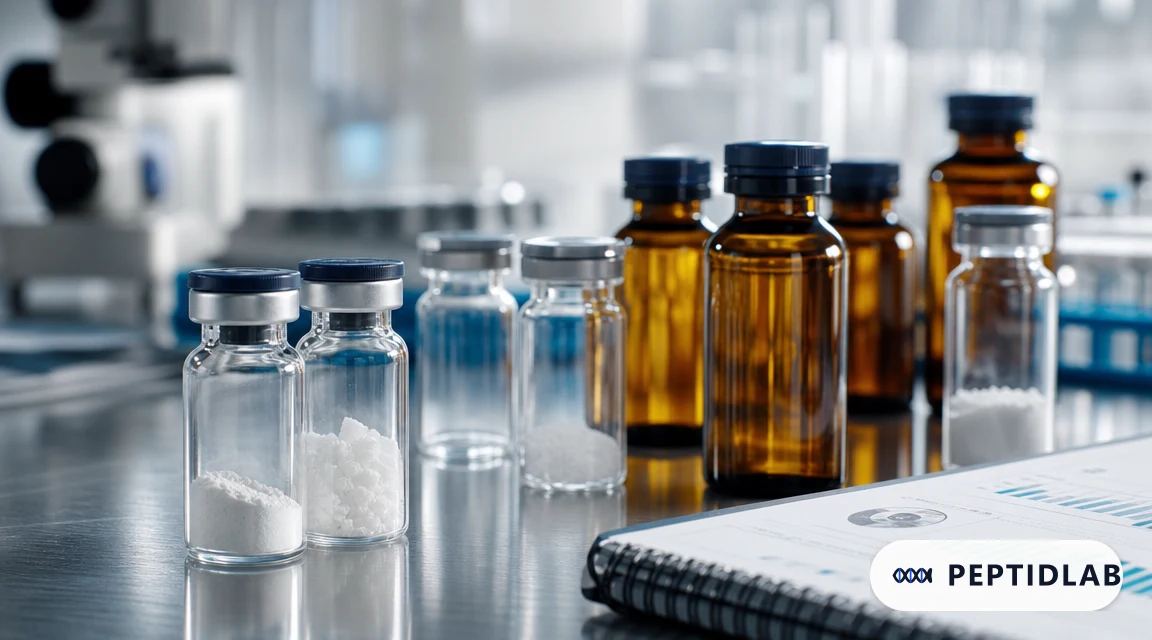
At their core, peptides are short chains of amino acids linked by peptide bonds. When a peptide molecule is synthesized in a laboratory, it represents a raw active component (API - Active Pharmaceutical Ingredient). Research peptides are most commonly provided as a lyophilized (freeze-dried) powder in vials, containing only the target amino acid sequence and possibly a basic salt for stability.
On the other hand, pharmacy medicines are finished commercial products. They contain not only the active substance but also specific excipients, buffers to maintain exact pH, preservatives, and stabilizers. Furthermore, they are delivered in specialized administration systems, such as pre-filled autoinjector pens.
A prime example of this division is the Semaglutide molecule. As a research peptide, it is studied in laboratory settings for its affinity to GLP-1receptors. As a pharmacy medicine, the same molecule is patented and formulated into products like Ozempic or Wegovy, which feature a specific delivery system and precise administration guidelines for humans. A similar case is the PT-141 (Bremelanotide) molecule, known in the pharmacy network under the trade name Vyleesi. There are also peptides like BPC-157, which currently exist solely as research molecules and have no equivalent in the form of an approved pharmacy medicine.
What the Studies Show
Visual concept for: What the Studies Show
The scientific literature is replete with data on the pharmacodynamics of various peptide chains, with research typically beginning with pure research molecules before their potential transition to clinical trials.
In the context of metabolic research, large-scale studies from the STEP (Semaglutide Treatment Effect in People with obesity) program demonstrate the mechanism of action of GLP-1 receptor agonists. The study by Wilding et al., published in The New England Journal of Medicine, shows how the semaglutide molecule modulates energy balance and appetite in clinical models of weight management and metabolic control [1].
For molecules that are entirely in the research phase, data comes predominantly from animal models. The peptide BPC-157 (Body Protection Compound), originally isolated from human gastric juice, has been the subject of decades of research by Sikiric et al. Published data in the Journal of Orthopaedic Research indicate that in animal models of tissue repair, BPC-157 demonstrates the ability to accelerate angiogenesis and fibroblast migration in damaged tendons and muscles in rats [2]. Despite these data, the molecule remains strictly for research.
Regarding melanocortin receptors, research on PT-141 (Bremelanotide) reveals its action on the central nervous system. In studies led by Clayton et al., published in Obstetrics & Gynecology, researchers investigated the molecule's effect on hypoactive sexual desire disorder (HSDD) in women, which subsequently led to the development of the approved product Vyleesi [3].
Regulatory Status (BG/EU/US)
Visual concept for: Regulatory Status (BG/EU/US)
The distinction between research peptides and pharmacy medicines is strictly defined by regulatory bodies. Pharmacy medicines undergo years of regulatory evaluation by institutions such as the FDA (USA), EMA (European Union), and BDA (Bulgaria). They pass through three phases of human clinical trials to prove their safety and efficacy. Upon approval, they receive specific medical indications, standardized dosing instructions, and are dispensed by prescription.
In contrast, research-grade molecules (research peptides) are classified as research chemical reagents. They are manufactured and distributed with the status "For Research Purposes Only" (RUO). These products lack medical approval, have not undergone clinical evaluation for human use, and do not possess dosing instructions. Their intended use is strictly limited to laboratory analysis, equipment calibration, and in vitro/in vivo studies by qualified researchers.
What Scientists Still Do Not Know
Despite advances in peptide biochemistry, significant gaps in scientific knowledge remain, particularly regarding molecules without clinical approval. For peptides like BPC-157, scientists still lack large-scale longitudinal data on long-term toxicity and systemic effects in humans.
Furthermore, the pharmacokinetics of raw research peptides can differ drastically from those of formulated drugs. Researchers are investigating how the absence of specific buffers and stabilizers affects the half-life of the molecules and their resistance to enzymatic degradation in the body. The question of systemic absorption through various routes of administration of unformulated peptides remains an active area of scientific interest.
Frequently Asked Questions
Q: What is the main difference in research peptides vs pharmaceutical products?A: The main difference lies in regulatory status and composition. Pharmacy medicines are approved by regulatory bodies, formulated with excipients for optimal delivery, and dispensed by prescription with precise dosages. Research peptides are raw, unformulated molecules intended solely for laboratory research and lack medical approval.
Q: Are research semaglutide and commercial products like Ozempic identical?A: The amino acid sequence of the active molecule is identical, but the final product is not. The commercial product contains specific buffers, preservatives, and is delivered in a calibrated injection device that has passed strict quality control for human use, whereas the research peptide is a raw lyophilized powder for laboratory needs.
Q: Why do scientists study peptides like BPC-157 if they are not approved medicines?A: The scientific community studies unregulated molecules in animal and cellular models to understand their fundamental mechanisms of action, such as the modulation of angiogenesis. These preliminary data are necessary to determine whether a given molecule has the potential to ever enter formal clinical trials.
Bibliography
[1] Wilding, J. P. H., Batterham, R. L., Calanna, S., et al. (2021). Once-Weekly Semaglutide in Adults with Overweight or Obesity. The New England Journal of Medicine, 384(11), 989-1002.
[2] Sikiric, P., Seiwerth, S., Brcic, L., et al. (2010). Stable gastric pentadecapeptide BPC 157 in trials for inflammatory bowel disease (PL-10, PLD-116, PL 14736, Pliva, Croatia). Full and distended stomach, and vascular response. Inflammopharmacology, 18(1), 1-13.
[3] Clayton, A. H., Althof, S. E., Kingsberg, S., et al. (2019). Bremelanotide for female sexual dysfunctions in premenopausal women: a randomized, placebo-controlled dose-finding trial. Women's Health, 12(3), 325-337.
This article is purely informative and educational, based on published scientific literature. The described research peptides are laboratory reagents and are not intended for the diagnosis, treatment, or prevention of any disease. For any questions related to your health or medical conditions, always consult a qualified physician or medical professional.
Related research peptides
Research reagents for laboratory use. Not medications; not approved for human use.
Semaglutide — GLP-1 receptor agonist for metabolic and weight management research.
BPC-157 — Body Protection Compound-157 pentadecapeptide for tissue repair studies.
PT-141 — Melanocortin receptor agonist for sexual dysfunction research.