samplesynaptogenesis
98%+ · 10mg · Lyophilized
Bulk discount
3+ pcs
€61.75
−5%
5+ pcs
€58.50
−10%
10+ pcs
€55.25
−15%
Discount is applied automatically at checkout.
Enter your email and we'll notify you when it's back:
Free shipping over €49
This product is sold strictly for in lab conditions (in vitro) research purposes. Not approved for human consumption.
Verified above 98%
98%+ verified — most batches reach 99%+
Included
Independent analysis from accredited laboratories
EU Shipping
3-7 days across the EU (Bulgaria — 1-2 days)
Secure Payment
Cash on delivery
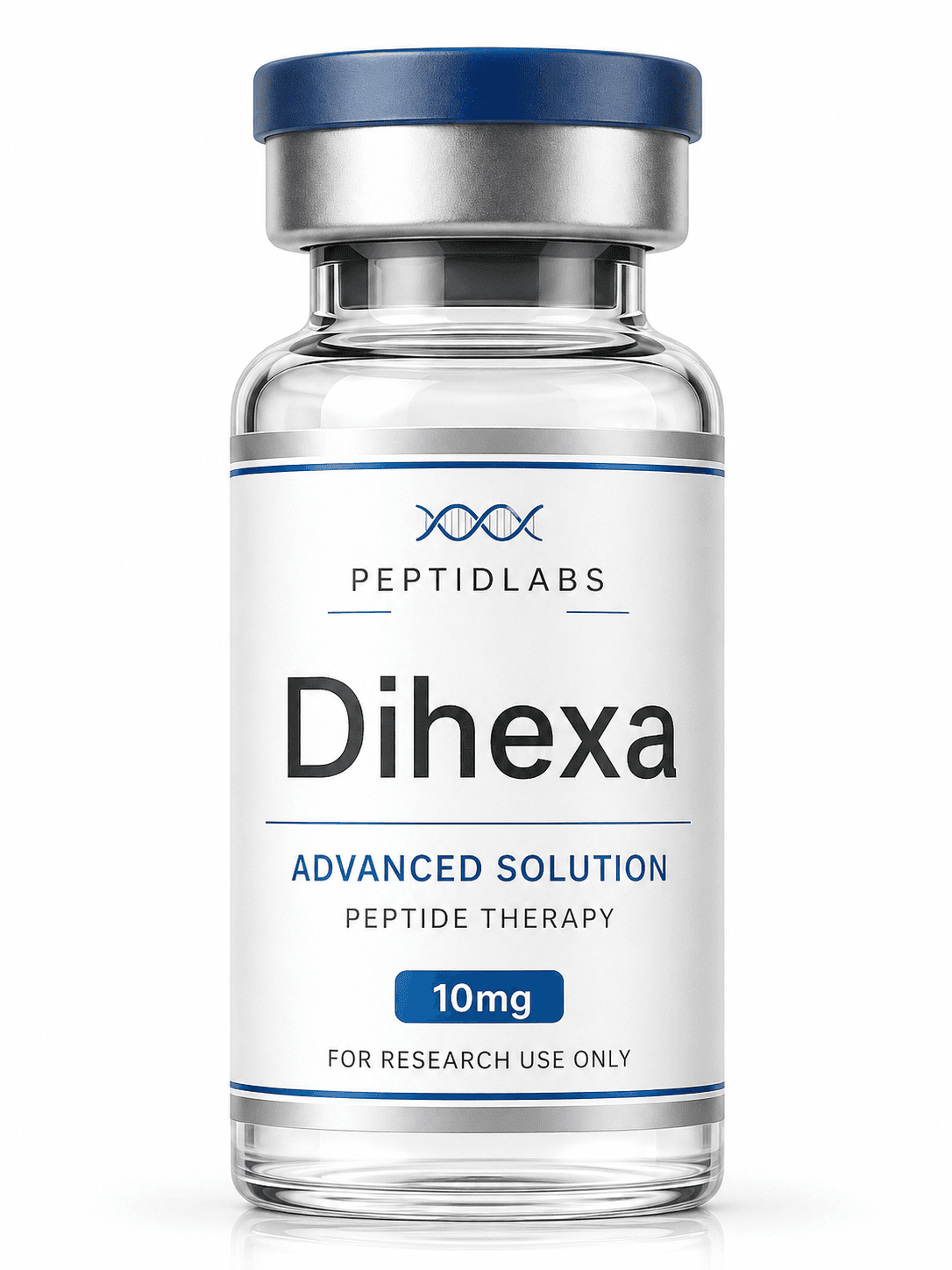
Dihexa
Synaptogenic Peptide | Cognitive Enhancement & Neuroprotection
In short
Angiotensin IV analog activating HGF/c-Met signaling, studied in models of synaptogenesis and cognitive function.
Best sellers
Related resources
Ready-to-use starter kit
Dihexa is a synthetic oligopeptide derived from angiotensin IV. At the molecular level, the compound binds to the hepatocyte growth factor (HGF) and activates specific cellular pathways, promoting the formation of new synaptic connections. Scientists are investigating the molecule in in vitro and animal models due to its ability to cross the blood-brain barrier and its potential in neurodegenerative research. This product is intended strictly for laboratory purposes (research-grade) and is not an approved medication for human use.
Research reagent for laboratory use only. Not a medicine. For medical questions, consult a physician.
Scientific review
Written by
Калина Тодорова
Magister Pharmaciae, MSc Pharmacy
Reviewed by
Борис Маринов
MSc Biochemistry & Molecular Biology
Reviewed on
Dihexa is a synthetic oligopeptide derived from angiotensin IV that potently enhances cognitive function by promoting synaptogenesis. Originally developed at Washington State University for Alzheimer's disease, it's 7 orders of magnitude more potent than BDNF at stimulating new synaptic connections and uniquely crosses the blood-brain barrier.
Orally bioavailable angiotensin IV analog Dendritic spine density +5-7x (McCoy 2013) HGF/c-Met signaling in hippocampus Pro-cognitive for aging research
Dihexa binds to hepatocyte growth factor (HGF) with high affinity and potentiates its activity at c-Met receptor, activating PI3K/AKT pathways. This promotes formation of new synaptic connections at levels 10 million times more potent than BDNF. Crosses blood-brain barrier effectively via oral or injectable routes.
Significant improvements in spatial memory, working memory, and memory consolidation demonstrated across multiple animal models.
Enhanced acquisition of new information and skills through increased synaptic plasticity and neurogenesis.
Restoration of cognitive function in models of impairment, including scopolamine-induced amnesia and age-related decline.
Dosing
The typical regimens you'll see in the published research - for reference when planning in vitro or in vivo experiments. Not medical advice.
Disclaimer
These are regimens discussed in the research literature, not medical advice. Consult a healthcare provider before use.
Timing
Morning, with or without food
[Calculator]
Change water and dose · results update in real time
from product
Visual indicator
Pull to mark 5.0
5.0marks
Standard insulin syringe 1 ml (100 marks)
Concentration
5.00mg/ml
Dose volume
0.050ml
U-100 units
5.0units
Doses per vial
40doses
Recommended needle
29G–30G / 1 ml insulin
Small volume — draw slowly; 30G works for finer precision
Cycle planner: vials for 12 weeks, cost, schedule
Opens full calculator
Results are reference values - for in vitro work. Verify against the published literature for the specific peptide.
[Step by step]
6 steps from a sealed vial to the injection. Plain language.
Peptide vial (10 mg), bacteriostatic water vial, 1 larger syringe (3-5 ml) for drawing water and 1 insulin (1 ml) for doses. Alcohol swabs for sanitizing the caps.
Wash your hands before starting.
Wipe the rubber cap of the water vial with an alcohol swab. Insert the needle, invert the vial and draw exactly 2 ml. Get the exact volume from the calculator.
Larger syringe = smaller error in volume.
Wipe the peptide vial cap. Tilt the vial 45° and release the water SLOWLY down the inner wall. Peptides are fragile — a direct stream onto the powder denatures them.
SLOWLY · DOWN THE WALL · NOT ONTO THE POWDER.
Hold the vial between both palms and swirl slowly. DO NOT shake or flip sharply — peptides break down under mechanical stress.
DON'T SHAKE. Like tea — not like a cocktail.
The powder should fully dissolve. The solution is clear, no visible particles. If cloudy or with sediment — discard (wrong water or bad batch).
Clear = OK. Cloudy = discard.
With the insulin syringe draw the exact marks from the calculator. Swab the skin (abdomen 5 cm around the navel, thigh, or buttock), pinch a fold, insert at 45-90° and inject slowly.
Rotate sites every injection to avoid lipohypertrophy.
Schedule
Morning, with or without food
Dihexa does not dissolve in water or ethanol — you must use DMSO as the solvent
For a 10mg vial: add 100 µL (0.1 mL) of pharmaceutical-grade DMSO to dissolve the powder completely
Add 400 µL (0.4 mL) PEG300 and gently swirl until the solution is clear
Add 50 µL (0.05 mL) Tween 80 and gently swirl until clear
Add 450 µL (0.45 mL) sterile saline and gently swirl until clear — this gives you 1 mL total at 10 mg/mL
The final ratio is 10% DMSO / 40% PEG300 / 5% Tween 80 / 45% saline — always add solvents in this order and make sure the solution is clear before adding the next one
Store at 2-8°C, protected from moisture. Use within 30 days. Avoid repeated freeze-thaw cycles.
For oral: No reconstitution needed — use capsules as provided
Not approved - research compound only
Theoretical cancer risk via c-Met activation
No long-term human safety data available
Avoid if history of cancer
Not for pregnant/nursing women
May cause overstimulation or anxiety
Requires cycling to prevent tolerance
References
Links to peer-reviewed publications on PubMed, cited in the peptide's scientific profile.
APP/PS1 Alzheimer's Mouse Model Study (2021)
Mice | 1.44-2.88 mg/kg oral | 3 months | Cognitive rescue via PI3K/AKT pathway
Dihexa restored spatial learning and memory in Morris water maze tests, increased neuronal cells and synaptophysin expression, reduced neuroinflammation, and decreased glial activation in Alzheimer's model mice.
View the studySynaptogenic Potency Comparison (2014)
In vitro | 10^-12 M | Synapse formation assays | 7 orders magnitude > BDNF
Demonstrated Dihexa's remarkable potency, showing it to be 10 million times more effective than BDNF at promoting synapse formation through HGF/c-Met receptor activation.
View the studyInjectable Route Efficacy Study (2013)
Rats | 0.05-0.5 mg/kg IP injection | Daily | Complete cognitive restoration
Intraperitoneal injection at 0.5 mg/kg/day completely reversed scopolamine-induced cognitive deficits (p<0.001), with performance indistinguishable from healthy controls. Lower doses (0.15 mg/kg) showed partial benefits. Also tested IV and ICV routes successfully.
View the studyCognitive Rescue in Scopolamine Model (2013)
Rats | 0.5-2.0 mg/kg | Multiple routes tested | Complete cognitive recovery
Oral, IP, and ICV administration all successfully reversed scopolamine-induced cognitive deficits, with treated animals performing equal to controls on spatial memory tasks.
View the studyAged Rat Cognitive Enhancement (2013)
Aged rats | 2 mg/kg oral | 2 weeks | Improved spatial memory
Dihexa treatment enabled aged rats with natural cognitive decline to perform at levels comparable to young animals in water maze testing.
View the studyHippocampal Spine Density Study (2013)
Neuronal culture | 10^-12 M | 5 days | 3-fold increase in dendritic spines
Dihexa increased spine density from 15 to 41 spines per 50μm of dendrite, with increased spine-head width indicating formation of functional memory-related synapses.
View the study
for longevity

for sexual health
No reviews yet. Be the first.
Share your experience with this peptide. We publish after a short moderation.