samplesenolytic
98%+ · 5mg · Lyophilized
Bulk discount
3+ pcs
€94.05
−5%
5+ pcs
€89.10
−10%
10+ pcs
€84.15
−15%
Discount is applied automatically at checkout.
Enter your email and we'll notify you when it's back:
Free shipping over €49
This product is sold strictly for in lab conditions (in vitro) research purposes. Not approved for human consumption.
Verified above 98%
98%+ verified — most batches reach 99%+
Included
Independent analysis from accredited laboratories
EU Shipping
3-7 days across the EU (Bulgaria — 1-2 days)
Secure Payment
Cash on delivery
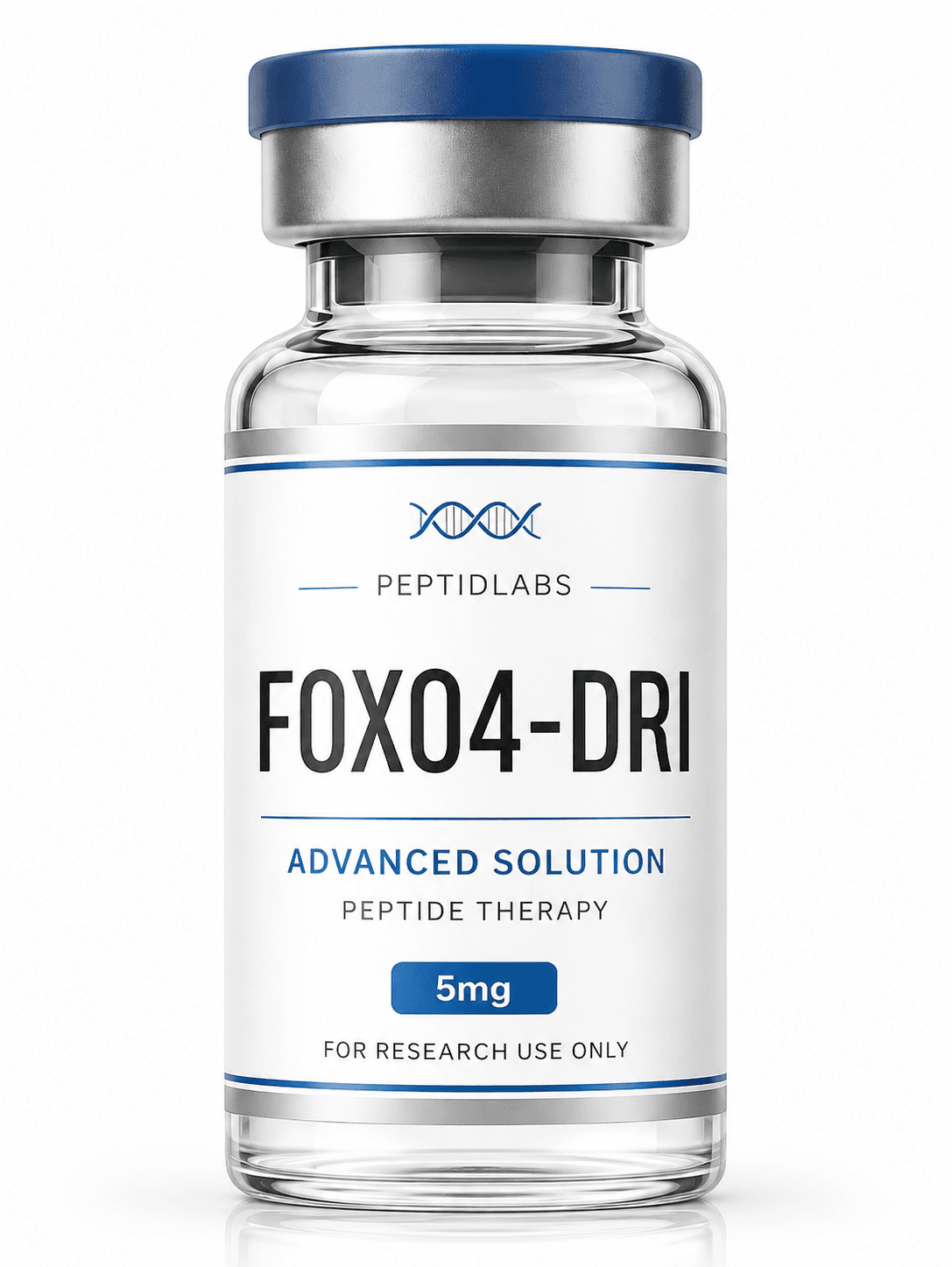
FOXO4-DRI
Senolytic Peptide | FOXO4-p53 Disruption for Cellular Aging Research
In short
D-retro-inverso peptide studied as a senolytic for selectively inducing apoptosis in senescent cell lines.
Best sellers
Related resources
Ready-to-use starter kit
FOXO4-DRI is a synthetic peptide engineered with a reversed amino acid sequence to make it highly resistant to degradation. At the molecular level, it disrupts the interaction between FOXO4 and p53 proteins, selectively triggering programmed cell death (apoptosis) in damaged, aging (senescent) cells while leaving healthy cells unharmed. Researchers are studying this mechanism in vitro and in animal models to evaluate its ability to clear dysfunctional cells that accumulate with age. This compound is strictly for laboratory research purposes and is not an approved medication or medical treatment for human use.
Research reagent for laboratory use only. Not a medicine. For medical questions, consult a physician.
Scientific review
Written by
Калина Тодорова
Magister Pharmaciae, MSc Pharmacy
Reviewed by
Борис Маринов
MSc Biochemistry & Molecular Biology
Reviewed on
FOXO4-DRI (FOXO4-D-Retro-Inverso) is a synthetic 46-amino acid peptide designed to selectively eliminate senescent cells -damaged cells that accumulate with age and secrete harmful inflammatory factors (SASP). The peptide uses D-amino acids in reversed sequence, making it resistant to proteolytic degradation while maintaining binding function. FOXO4-DRI works by disrupting the FOXO4-p53 interaction that keeps senescent cells alive, causing p53 nuclear exclusion and redirecting it to mitochondria to trigger apoptosis. In mouse studies, it restored fur density, renal function, and physical fitness in aged animals while protecting against chemotherapy-induced toxicity. Notably, it shows 11.73-fold selectivity for senescent over healthy cells. No human clinical trials have been conducted; all efficacy data comes from preclinical animal and cell studies. The peptide was first described by Dr. Peter de Keizer and colleagues at Erasmus University Medical Center in 2017.
D-retro-inverso senolytic peptide Selective senescent cell elimination Restored function in aged mice (Cell 2017) SASP reduction 60-80%
Disrupts FOXO4-p53 interaction in senescent cells, causing p53 nuclear exclusion. Free p53 translocates to mitochondria, triggering caspase-dependent apoptosis specifically in senescent cells while sparing healthy cells (11.73-fold selectivity demonstrated).
Selectively eliminates 'zombie' senescent cells that accumulate with age and secrete harmful inflammatory factors (SASP)
Mouse studies show restoration of tissue function including fur regrowth, renal function, and physical fitness
Dosing
The typical regimens you'll see in the published research - for reference when planning in vitro or in vivo experiments. Not medical advice.
Disclaimer
These are regimens discussed in the research literature, not medical advice. Consult a healthcare provider before use.
Timing
No established optimal timing. Cellular uptake occurs within 2-4 hours, effects persist 72+ hours
[Calculator]
Change water and dose · results update in real time
from product
Visual indicator
Pull to mark 10
10marks
Standard insulin syringe 1 ml (100 marks)
Concentration
2.50mg/ml
Dose volume
0.100ml
U-100 units
10units
Doses per vial
20doses
Recommended needle
29G–30G / 1 ml insulin
Small volume — draw slowly; 30G works for finer precision
Cycle planner: vials for 12 weeks, cost, schedule
Opens full calculator
Results are reference values - for in vitro work. Verify against the published literature for the specific peptide.
[Step by step]
6 steps from a sealed vial to the injection. Plain language.
Peptide vial (5 mg), bacteriostatic water vial, 1 larger syringe (3-5 ml) for drawing water and 1 insulin (1 ml) for doses. Alcohol swabs for sanitizing the caps.
Wash your hands before starting.
Wipe the rubber cap of the water vial with an alcohol swab. Insert the needle, invert the vial and draw exactly 2 ml. Get the exact volume from the calculator.
Larger syringe = smaller error in volume.
Wipe the peptide vial cap. Tilt the vial 45° and release the water SLOWLY down the inner wall. Peptides are fragile — a direct stream onto the powder denatures them.
SLOWLY · DOWN THE WALL · NOT ONTO THE POWDER.
Hold the vial between both palms and swirl slowly. DO NOT shake or flip sharply — peptides break down under mechanical stress.
DON'T SHAKE. Like tea — not like a cocktail.
The powder should fully dissolve. The solution is clear, no visible particles. If cloudy or with sediment — discard (wrong water or bad batch).
Clear = OK. Cloudy = discard.
With the insulin syringe draw the exact marks from the calculator. Swab the skin (abdomen 5 cm around the navel, thigh, or buttock), pinch a fold, insert at 45-90° and inject slowly.
Rotate sites every injection to avoid lipohypertrophy.
Schedule
No established optimal timing. Cellular uptake occurs within 2-4 hours, effects persist 72+ hours
Store lyophilized powder at -20°C until use
Allow vial to reach room temperature before reconstitution
Add sterile water slowly down vial side
Gently swirl until dissolved -do not shake (protein may denature)
Solution should be clear; discard if cloudy or precipitated
Use reconstituted solution within 7-10 days
Store reconstituted at 2-8°C
CRITICAL: No human clinical trials -all safety data from animal studies
Original mouse studies showed no thrombocytopenia (unlike ABT-737)
No cardiac abnormalities on histology in mouse studies
Does not sensitize healthy cells to DNA damage
Anecdotal: Burning/itching at injection site reported
Avoid concurrent use with Rapamycin, Quercetin, corticosteroids
May not be useful for healthy individuals under 40 with low senescent cell burden
Theoretical concern: p53 pathway critical for tumor suppression
Unknown immunogenicity with repeated dosing
References
Links to peer-reviewed publications on PubMed, cited in the peptide's scientific profile.
Targeted Apoptosis of Senescent Cells Restores Tissue Homeostasis (2017)
Mouse | 5 mg/kg IV | 3 doses every other day | Fast-aging & naturally aged mice
Landmark study introducing FOXO4-DRI. Demonstrated 11.73-fold selectivity for senescent cells. In aged mice, restored fur density, normalized renal function (plasma urea/creatinine), increased voluntary running activity, and protected against doxorubicin-induced liver damage. No thrombocytopenia or cardiac abnormalities observed.
View the studyFOXO4-DRI Alleviates Age-Related Testosterone Secretion Insufficiency (2020)
Mouse | 5 mg/kg IP | Every other day × 3 | Aged mice (20-24 months)
Treatment significantly increased serum testosterone levels in aged mice. Enhanced expression of testosterone synthesis enzymes (3β-HSD, CYP11A1). Decreased testicular senescence markers (p53, p21, p16) and reduced inflammatory cytokines (IL-1β, IL-6, TGF-β). No toxicity to normal Leydig cells.
View the studySenolytic FOXO4-DRI Removes Senescent Human Chondrocytes (2021)
Human cells in vitro | Passaged chondrocytes | Senescence model
Removed over 50% of highly-passaged senescent chondrocytes (PDL9) while not affecting minimally-passaged cells (PDL3). Reduced senescence markers and improved cartilage quality. However, did not enhance chondrogenic potential of treated cells.
View the studyFOXO4-DRI Ameliorates Bleomycin-Induced Pulmonary Fibrosis (2022)
Mouse | BLM-induced fibrosis model | Therapeutic administration
Similar efficacy to approved drug Pirfenidone. Decreased senescent cells, downregulated SASP factors, attenuated collagen deposition. Increased type 2 alveolar epithelial cells while selectively killing TGF-β-induced myofibroblasts.
View the studyFOXO4-DRI Targets ECM Production in Pulmonary Fibrosis (2023)
Mouse | Bleomycin model | ECM pathway analysis
Confirmed FOXO4-DRI resets p53 nuclear distribution and decreases total ECM protein content. Therapeutic administration showed milder pathologic changes and less collagen deposition than untreated fibrosis group.
View the study
for longevity

for sexual health
No reviews yet. Be the first.
Share your experience with this peptide. We publish after a short moderation.