samplefor GH and cardioprotection
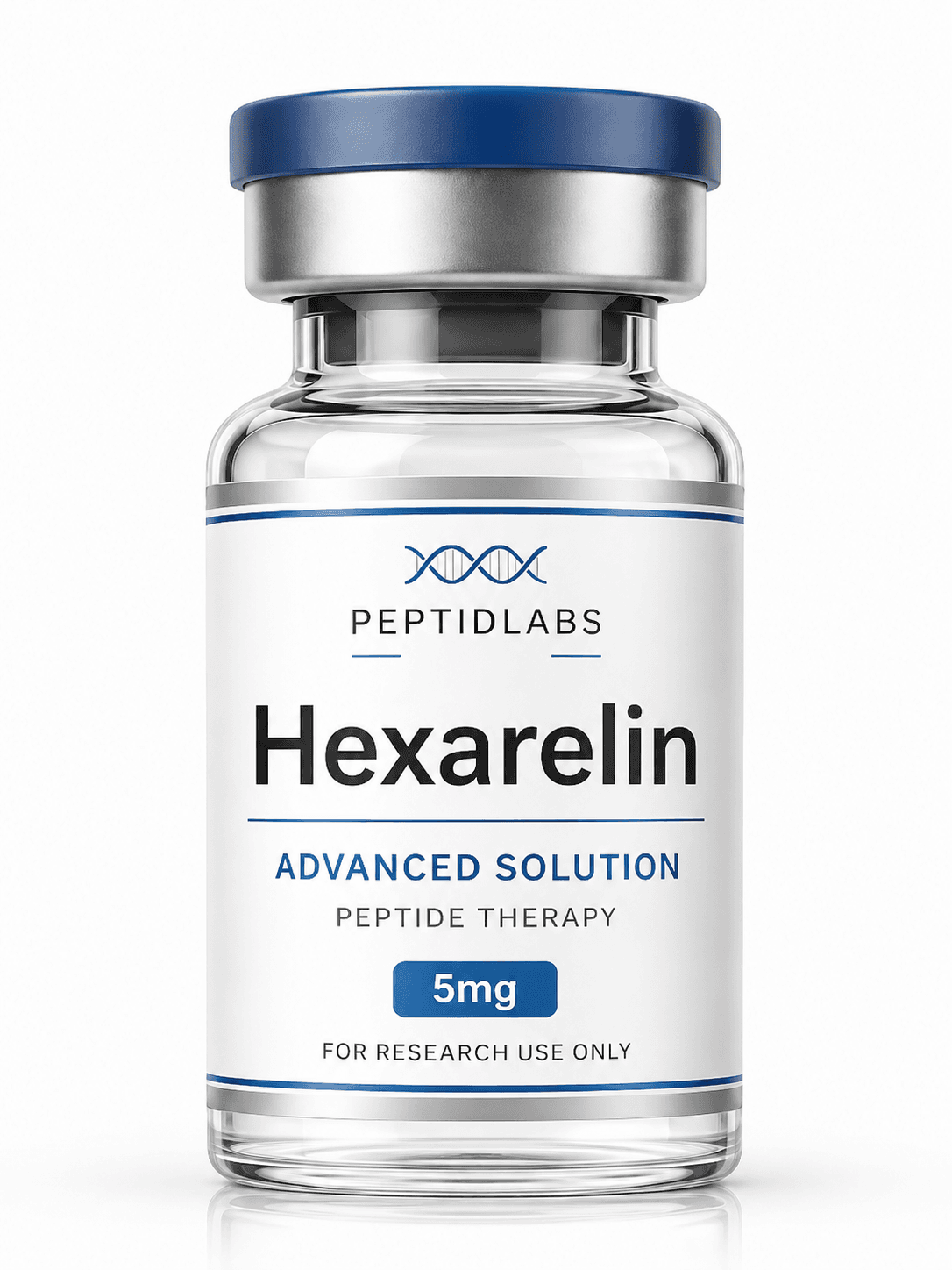
99%+ · 5mg · Lyophilized
Bulk discount
3+ pcs
€26.60
−5%
5+ pcs
€25.20
−10%
10+ pcs
€23.80
−15%
Discount is applied automatically at checkout.
Enter your email and we'll notify you when it's back:
Free shipping over €49
This product is sold strictly for in lab conditions (in vitro) research purposes. Not approved for human consumption.
Verified above 98%
98%+ verified — most batches reach 99%+
Included
Independent analysis from accredited laboratories
EU Shipping
3-7 days across the EU (Bulgaria — 1-2 days)
Secure Payment
Cash on delivery
Hexarelin
Hexapeptide GHRP | Growth Hormone Release & Cardioprotection
In short
Modified GHRP class peptide studied as a potent stimulator of growth hormone via GHS-R1a receptor activation.
Best sellers
Related resources
Ready-to-use starter kit
Hexarelin (also known as Examorelin) is a synthetic peptide belonging to the group of growth hormone-releasing secretagogues. At the molecular level, it binds to ghrelin receptors in the pituitary gland to trigger growth hormone secretion and activates specific CD36 receptors in cardiac tissue. In laboratory (in vitro) and animal models, researchers are studying the molecule for its potential cardioprotective mechanisms and cellular effects. This product is strictly for scientific research purposes and is not an approved medication for human consumption.
Research reagent for laboratory use only. Not a medicine. For medical questions, consult a physician.
Scientific review
Written by
Калина Тодорова
Magister Pharmaciae, MSc Pharmacy
Reviewed by
Борис Маринов
MSc Biochemistry & Molecular Biology
Reviewed on
Hexarelin (also known as Examorelin) is a synthetic hexapeptide growth hormone releasing peptide (GHRP) and one of the most potent GH secretagogues studied. Derived from GHRP-6 by Mediolanum Farmaceutici, it stimulates growth hormone release through the ghrelin receptor (GHS-R1a) and uniquely binds to cardiac CD36 receptors, providing cardioprotective effects independent of GH release. Hexarelin reached Phase II clinical trials for growth hormone deficiency and congestive heart failure but was discontinued in 2005 for strategic reasons. Research demonstrates its potential in cardioprotection, neuroprotection, and metabolic regulation.
3-5x higher GHS-R1a affinity than GHRP-6 GH +10-20x baseline (Imbimbo 1994) CD36-mediated cardioprotection Cyclic protocols required due to desensitization
Binds to ghrelin receptor (GHS-R1a) on pituitary somatotrophs to stimulate pulsatile GH release. Also activates cardiac CD36 receptors providing GH-independent cardioprotection through anti-apoptotic and anti-fibrotic mechanisms.
Most potent GHRP studied, stimulating dose-dependent GH release with peak levels at 30 minutes post-injection
Increases insulin-like growth factor 1 through enhanced pituitary GH secretion
Preserves natural GH secretion rhythm when dosed appropriately throughout the day
Dosing
The typical regimens you'll see in the published research - for reference when planning in vitro or in vivo experiments. Not medical advice.
Disclaimer
These are regimens discussed in the research literature, not medical advice. Consult a healthcare provider before use.
Timing
Morning upon waking, midday (optional), and 30 minutes before bed. Administer on empty stomach.
[Calculator]
Change water and dose · results update in real time
from product
Visual indicator
Pull to mark 10
10marks
Standard insulin syringe 1 ml (100 marks)
Concentration
2.50mg/ml
Dose volume
0.100ml
U-100 units
10units
Doses per vial
20doses
Recommended needle
29G–30G / 1 ml insulin
Small volume — draw slowly; 30G works for finer precision
Cycle planner: vials for 12 weeks, cost, schedule
Opens full calculator
Results are reference values - for in vitro work. Verify against the published literature for the specific peptide.
[Step by step]
6 steps from a sealed vial to the injection. Plain language.
Peptide vial (5 mg), bacteriostatic water vial, 1 larger syringe (3-5 ml) for drawing water and 1 insulin (1 ml) for doses. Alcohol swabs for sanitizing the caps.
Wash your hands before starting.
Wipe the rubber cap of the water vial with an alcohol swab. Insert the needle, invert the vial and draw exactly 2 ml. Get the exact volume from the calculator.
Larger syringe = smaller error in volume.
Wipe the peptide vial cap. Tilt the vial 45° and release the water SLOWLY down the inner wall. Peptides are fragile — a direct stream onto the powder denatures them.
SLOWLY · DOWN THE WALL · NOT ONTO THE POWDER.
Hold the vial between both palms and swirl slowly. DO NOT shake or flip sharply — peptides break down under mechanical stress.
DON'T SHAKE. Like tea — not like a cocktail.
The powder should fully dissolve. The solution is clear, no visible particles. If cloudy or with sediment — discard (wrong water or bad batch).
Clear = OK. Cloudy = discard.
With the insulin syringe draw the exact marks from the calculator. Swab the skin (abdomen 5 cm around the navel, thigh, or buttock), pinch a fold, insert at 45-90° and inject slowly.
Rotate sites every injection to avoid lipohypertrophy.
Schedule
Morning upon waking, midday (optional), and 30 minutes before bed. Administer on empty stomach.
Clean both vial tops with alcohol and let dry completely
For 2mg vial: Add 2mL bacteriostatic water (creates 100mcg per 10 units)
For 5mg vial: Add 2.5mL bacteriostatic water (creates 200mcg per 10 units)
Inject water slowly down the side of the vial to prevent foaming
Gently swirl or roll vial - do not shake vigorously
Solution should be clear and colorless
Label with reconstitution date and concentration
Store immediately in refrigerator at 2-8°C
Most potent but also highest side effect profile among GHRPs
Elevates cortisol and prolactin at standard doses - unlike Ipamorelin
May cause water retention, particularly in first 1-2 weeks
Can affect glucose metabolism - monitor if diabetic or pre-diabetic
Not recommended for those with active cancer due to growth-promoting effects
WADA prohibited substance - banned in competitive sports
Secondary hypogonadism possible with prolonged use due to prolactin elevation
Partial desensitization is normal and reversible with cycling
Compatibility
The pairings below come from research literature and established biohacker stacking patterns. Click a card for the full reasoning - when the partner is in our catalog you'll see a direct order link too.
This is a literature overview, not medical advice. Pairs not listed are not proven safe - they simply lack enough published data.
References
Links to peer-reviewed publications on PubMed, cited in the peptide's scientific profile.
Growth Hormone-Releasing Activity of Hexarelin in Humans (1994)
Human | 0.5-2 μg/kg IV | Single dose | 12 adult males
Double-blind, placebo-controlled dose-response study demonstrating dose-dependent GH release. Peak plasma GH at 30 minutes, returning to baseline within 240 minutes. Cmax values: 26.9 ng/ml (0.5 μg/kg), 52.3 ng/ml (1 μg/kg), 55.0 ng/ml (2 μg/kg) vs 3.9 ng/ml placebo.
View the studyHexarelin Treatment Preserves Myocardial Function After MI (2018)
Mouse model | 0.3 mg/kg/day SubQ | 21 days | LAD ligation
Demonstrated significant improvement in LV function after 14 days. Hexarelin treatment reduced LV collagen concentration by ~53%, decreased inflammatory cytokines (TNF-α, IL-1β), and shifted autonomic balance toward parasympathetic predominance.
View the studyProtective Effects of Hexarelin in ALS Neuroblastoma Model (2023)
In vitro | 1 μM | Human neuroblastoma cells | SOD1-G93A mutation
Hexarelin protected cells from H2O2-induced cytotoxicity by increasing Bcl-2 expression, reducing caspase-3 activation, and modulating MAPK/Akt pathways. Significantly decreased γH2AX positive cells indicating DNA damage protection.
View the studyCardiovascular Action of Hexarelin Review (2014)
Review | Multiple studies | CD36 receptor mechanism
Comprehensive review establishing hexarelin's cardioprotective effects through CD36 cardiac receptor binding independent of GH release. Documented anti-apoptotic effects, reduced infarct size in ischemia-reperfusion, and improved LVEF by 6.7 percentage points in human volunteers.
View the studyHexarelin Desensitization Study (2000)
Human | SubQ twice daily | 16 weeks | 12 elderly subjects
Investigated long-term GH response attenuation. AUC-GH decreased significantly from baseline at weeks 4 and 16. Four weeks post-treatment, GH response recovered to baseline levels, demonstrating desensitization is partial and reversible.
View the studyHexarelin Pharmacokinetics in Rats (1999)
Rat model | IV and SubQ | Multiple doses | PK analysis
IV administration showed half-life of 75.9 min, clearance of 7.6 ml/min/kg, and Vd of 744 ml/kg. SubQ administration confirmed absence of accumulation with dose-independent clearance (12-15 ml/min/kg).
View the study
for longevity

for sexual health
No reviews yet. Be the first.
Share your experience with this peptide. We publish after a short moderation.