samplefor neuroprotection
98%+ · 10mg · Lyophilized
Bulk discount
3+ pcs
€42.65
−5%
5+ pcs
€40.41
−10%
10+ pcs
€38.16
−15%
Discount is applied automatically at checkout.
Enter your email and we'll notify you when it's back:
Free shipping over €49
This product is sold strictly for in lab conditions (in vitro) research purposes. Not approved for human consumption.
Verified above 98%
98%+ verified — most batches reach 99%+
Included
Independent analysis from accredited laboratories
EU Shipping
3-7 days across the EU (Bulgaria — 1-2 days)
Secure Payment
Cash on delivery
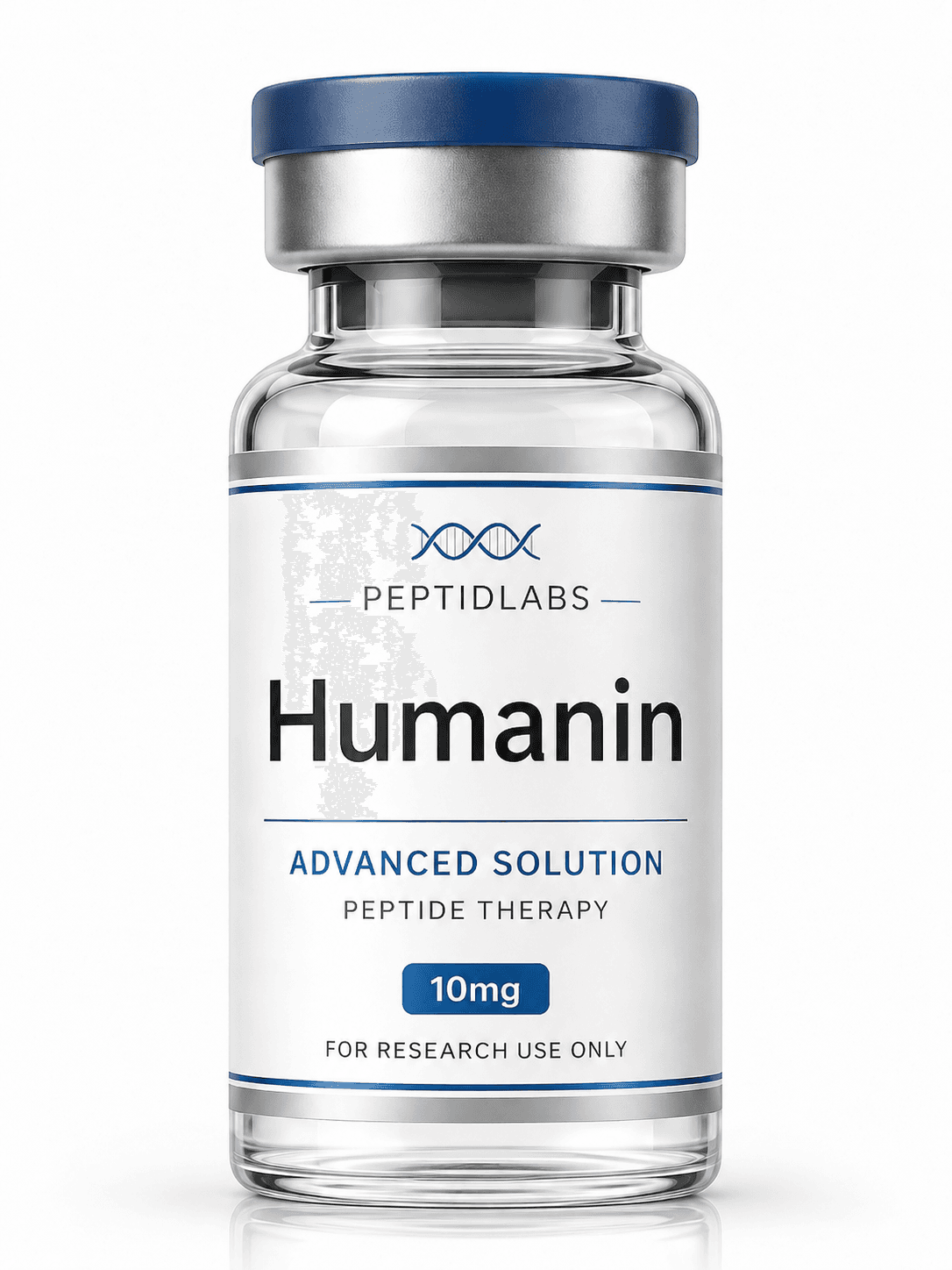
Humanin
Mitochondrial micropeptide | Neuroprotection | Cellular survival
In short
Mitochondrially encoded peptide studied in cellular models for neuroprotection against amyloid-induced toxicity.
Best sellers
Related resources
Ready-to-use starter kit
Humanin is a micropeptide consisting of 24 amino acids that is naturally encoded within the mitochondrial genome of cells. At the molecular level, it binds to and inhibits the BAX protein, thereby preventing programmed cell death and protecting cells from oxidative stress. The molecule is currently being investigated in in vitro and animal models to understand its role in neurodegenerative research and cellular aging. This product is strictly for laboratory research purposes and is not an approved medication or treatment for human use.
Research reagent for laboratory use only. Not a medicine. For medical questions, consult a physician.
Scientific review
Written by
Калина Тодорова
Magister Pharmaciae, MSc Pharmacy
Reviewed by
Борис Маринов
MSc Biochemistry & Molecular Biology
Reviewed on
Humanin is a 24-amino acid micropeptide encoded within the mitochondrial genome, specifically the 16S ribosomal RNA gene. Discovered in 2001 during Alzheimer's disease research, it represents a rare class of peptides originating from mitochondrial DNA. The peptide functions as a potent cellular survival factor, protecting cells from oxidative stress and toxicity. Exogenous administration is investigated for its potential to support cellular longevity and metabolic function.
First mtDNA-derived peptide discovered (Hashimoto 2001) FPR2/ALX + BAX/BimEL - dual anti-apoptotic signaling Reduced amyloid-β neurotoxicity 70-90% Extended lifespan +10-15% in aged mice
Humanin exerts its cytoprotective effects primarily by binding to and inhibiting BAX, a pro-apoptotic protein. This interaction prevents BAX from translocating to the mitochondria, thereby halting the programmed cell death cascade. The peptide also binds to IGFBP-3, modulating insulin-like growth factor signaling and improving cellular metabolic efficiency.
Humanin demonstrates significant protective effects against neuronal cell death induced by amyloid-beta proteins. Research indicates it preserves cognitive function in animal models of neurodegeneration.
Dosing
The typical regimens you'll see in the published research - for reference when planning in vitro or in vivo experiments. Not medical advice.
Administer in the morning.
Monitor blood glucose levels during administration.
Disclaimer
These are regimens discussed in the research literature, not medical advice. Consult a healthcare provider before use.
Timing
Administer in the morning to align with natural metabolic rhythms.
[Calculator]
Change water and dose · results update in real time
from product
Visual indicator
Pull to mark 5.0
5.0marks
Standard insulin syringe 1 ml (100 marks)
Concentration
5.00mg/ml
Dose volume
0.050ml
U-100 units
5.0units
Doses per vial
40doses
Recommended needle
29G–30G / 1 ml insulin
Small volume — draw slowly; 30G works for finer precision
Cycle planner: vials for 12 weeks, cost, schedule
Opens full calculator
Results are reference values - for in vitro work. Verify against the published literature for the specific peptide.
[Step by step]
6 steps from a sealed vial to the injection. Plain language.
Peptide vial (10 mg), bacteriostatic water vial, 1 larger syringe (3-5 ml) for drawing water and 1 insulin (1 ml) for doses. Alcohol swabs for sanitizing the caps.
Wash your hands before starting.
Wipe the rubber cap of the water vial with an alcohol swab. Insert the needle, invert the vial and draw exactly 2 ml. Get the exact volume from the calculator.
Larger syringe = smaller error in volume.
Wipe the peptide vial cap. Tilt the vial 45° and release the water SLOWLY down the inner wall. Peptides are fragile — a direct stream onto the powder denatures them.
SLOWLY · DOWN THE WALL · NOT ONTO THE POWDER.
Hold the vial between both palms and swirl slowly. DO NOT shake or flip sharply — peptides break down under mechanical stress.
DON'T SHAKE. Like tea — not like a cocktail.
The powder should fully dissolve. The solution is clear, no visible particles. If cloudy or with sediment — discard (wrong water or bad batch).
Clear = OK. Cloudy = discard.
With the insulin syringe draw the exact marks from the calculator. Swab the skin (abdomen 5 cm around the navel, thigh, or buttock), pinch a fold, insert at 45-90° and inject slowly.
Rotate sites every injection to avoid lipohypertrophy.
Schedule
Administer in the morning to align with natural metabolic rhythms.
Humanin is primarily utilized in experimental and laboratory settings. Clinical administration protocols are not standardized.
Important
Humanin is primarily utilized in experimental and laboratory settings. Clinical administration protocols are not standardized.
Remove the humanin vial and bacteriostatic water from the refrigerator and allow them to reach room temperature.
Wipe the rubber stoppers of both vials with an alcohol swab.
Draw 2mL of bacteriostatic water into a sterile syringe.
Inject the water slowly into the humanin vial, aiming for the glass wall to prevent foaming.
Swirl the vial gently until the lyophilized powder is completely dissolved. Do not shake.
Store the reconstituted solution in the refrigerator immediately.
Long-term safety profile not yet established in human subjects.
Use only under medical supervision or in controlled research environments.
Inhibition of apoptosis carries theoretical risks regarding cellular proliferation.
May alter blood glucose dynamics and insulin requirements.
Potential interactions with and related metabolic pathways remain under investigation.
References
Links to peer-reviewed publications on PubMed, cited in the peptide's scientific profile.
A rescue factor abolishing neuronal cell death by a wide spectrum of familial Alzheimer's disease genes and Abeta
In vitro | Neuronal cells | Variable | Cell survival
Researchers identified humanin as a novel peptide that suppresses neuronal cell death caused by multiple Alzheimer's disease-related insults. The study established its primary role as a potent neuroprotective factor.
View the studyHumanin is a novel central regulator of peripheral insulin action
Animal | Rodent models | 4 weeks | Insulin sensitivity
The study demonstrated that central administration of humanin significantly improves hepatic and peripheral insulin sensitivity. It highlighted the peptide's role in regulating glucose metabolism and metabolic homeostasis.
View the studyInteraction between the Alzheimer's survival peptide humanin and insulin-like growth factor-binding protein 3 regulates cell survival and apoptosis
In vitro | Human cells | Variable | Apoptosis inhibition
Investigators found that humanin binds directly to IGFBP-3, preventing it from inducing apoptosis in cells. This interaction provides a secondary mechanism for humanin's broad cytoprotective effects.
View the study
for longevity

for sexual health
No reviews yet. Be the first.
Share your experience with this peptide. We publish after a short moderation.