sampleantimicrobial
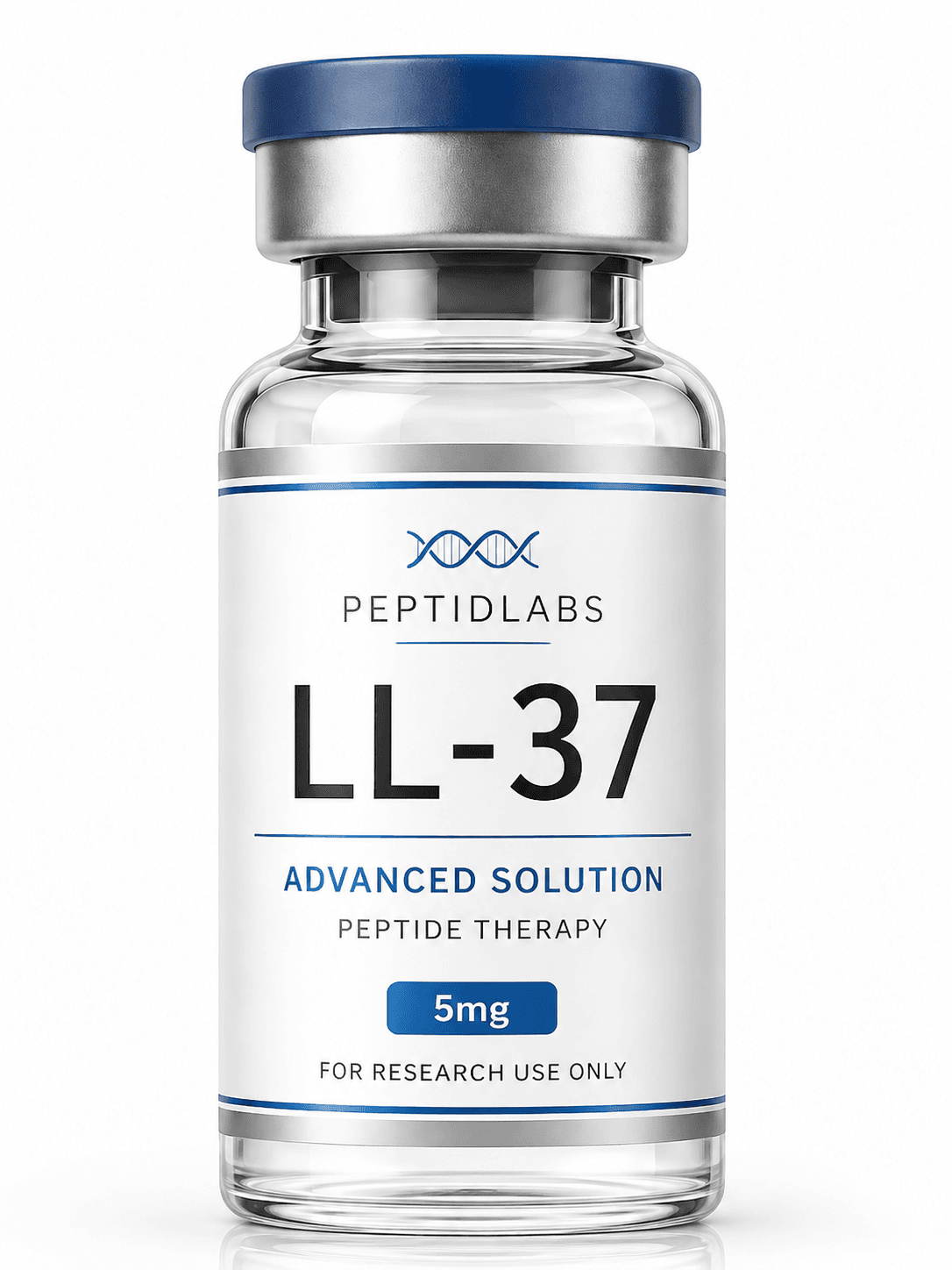
98%+ · 5mg · Lyophilized · MW: 4493.33
Bulk discount
3+ pcs
€61.75
−5%
5+ pcs
€58.50
−10%
10+ pcs
€55.25
−15%
Discount is applied automatically at checkout.
Enter your email and we'll notify you when it's back:
Free shipping over €49
This product is sold strictly for in lab conditions (in vitro) research purposes. Not approved for human consumption.
Verified above 98%
98%+ verified — most batches reach 99%+
Included
Independent analysis from accredited laboratories
EU Shipping
3-7 days across the EU (Bulgaria — 1-2 days)
Secure Payment
Cash on delivery
LL-37
Human Cathelicidin | Antimicrobial & Immune Support
In short
Antimicrobial peptide of the innate immune system studied for bactericidal action and modulation of tissue repair.
Best sellers
Related resources
Ready-to-use starter kit
LL-37 is a synthetic analogue of the only human cathelicidin antimicrobial peptide, consisting of 37 amino acids. At the molecular level, it interacts with the cell membranes of pathogens and plays a role in modulating the immune response. In laboratory settings (in vitro) and animal models, researchers are studying its broad-spectrum activity against bacteria, viruses, and fungi, alongside its role in tissue repair mechanisms. This product is strictly research-grade and is not an approved medication or medical treatment for human use.
Research reagent for laboratory use only. Not a medicine. For medical questions, consult a physician.
Scientific review
Written by
Калина Тодорова
Magister Pharmaciae, MSc Pharmacy
Reviewed by
Борис Маринов
MSc Biochemistry & Molecular Biology
Reviewed on
LL-37 is the only human cathelicidin antimicrobial peptide, a 37-amino acid cationic peptide derived from hCAP18 that exhibits broad-spectrum antimicrobial activity against bacteria, viruses, and fungi while modulating immune responses and promoting wound healing.
Cathelicidin class antimicrobial peptide Direct bactericidal + immunomodulatory FPR2 cytoprotective signaling Wound healing 30-50% acceleration
Subcutaneous administration provides systemic distribution for immune modulation and antimicrobial support throughout the body
Supports natural defense mechanisms against bacterial, viral, and fungal pathogens
Effective against multidrug-resistant bacteria including MRSA and MDRPA strains
Regulates inflammatory responses and supports balanced immune function
Dosing
The typical regimens you'll see in the published research - for reference when planning in vitro or in vivo experiments. Not medical advice.
Disclaimer
These are regimens discussed in the research literature, not medical advice. Consult a healthcare provider before use.
Timing
Evening administration preferred; can be taken with or without food
[Calculator]
Change water and dose · results update in real time
from product
Visual indicator
Pull to mark 10
10marks
Standard insulin syringe 1 ml (100 marks)
Concentration
2.50mg/ml
Dose volume
0.100ml
U-100 units
10units
Doses per vial
20doses
Recommended needle
29G–30G / 1 ml insulin
Small volume — draw slowly; 30G works for finer precision
Cycle planner: vials for 12 weeks, cost, schedule
Opens full calculator
Results are reference values - for in vitro work. Verify against the published literature for the specific peptide.
[Step by step]
6 steps from a sealed vial to the injection. Plain language.
Peptide vial (5 mg), bacteriostatic water vial, 1 larger syringe (3-5 ml) for drawing water and 1 insulin (1 ml) for doses. Alcohol swabs for sanitizing the caps.
Wash your hands before starting.
Wipe the rubber cap of the water vial with an alcohol swab. Insert the needle, invert the vial and draw exactly 2 ml. Get the exact volume from the calculator.
Larger syringe = smaller error in volume.
Wipe the peptide vial cap. Tilt the vial 45° and release the water SLOWLY down the inner wall. Peptides are fragile — a direct stream onto the powder denatures them.
SLOWLY · DOWN THE WALL · NOT ONTO THE POWDER.
Hold the vial between both palms and swirl slowly. DO NOT shake or flip sharply — peptides break down under mechanical stress.
DON'T SHAKE. Like tea — not like a cocktail.
The powder should fully dissolve. The solution is clear, no visible particles. If cloudy or with sediment — discard (wrong water or bad batch).
Clear = OK. Cloudy = discard.
With the insulin syringe draw the exact marks from the calculator. Swab the skin (abdomen 5 cm around the navel, thigh, or buttock), pinch a fold, insert at 45-90° and inject slowly.
Rotate sites every injection to avoid lipohypertrophy.
Schedule
Evening administration preferred; can be taken with or without food
Allow LL-37 vial to reach room temperature before reconstitution
Add appropriate volume of bacteriostatic water slowly to peptide vial
Gently swirl or roll vial to dissolve - do not shake vigorously
Calculate dose based on final concentration (typically 1-2 mg/mL)
Use sterile technique for injection preparation
Inject subcutaneously in abdomen, thigh, or upper arm areas
Rotate injection sites to prevent tissue irritation
Monitor injection sites for excessive irritation or inflammatory reactions
Start with lower doses (50-100 mcg) to assess individual tolerance
Discontinue if signs of hypersensitivity or allergic reactions develop
Use proper sterile injection technique to prevent contamination
References
Links to peer-reviewed publications on PubMed, cited in the peptide's scientific profile.
MRSA Biofilm Eradication Study (2019)
In vitro | 10-100 μM | 60 minutes | >4 log reduction in biofilm
CDC biofilm reactor study showing LL-37 achieved superior antimicrobial efficacy against Staphylococcus aureus biofilms compared to conventional antibiotics and silver nanoparticles.
View the studyMultidrug-Resistant Bacteria Study (2017)
Clinical isolates | 1-256 μg/mL MIC | Various pathogens | Broad-spectrum activity
Comprehensive antimicrobial profile study against human pathogens including antibiotic-resistant strains, demonstrating broad-spectrum activity and potential as alternative to conventional antibiotics.
View the studyVenous Leg Ulcer Clinical Trial (2014)
Humans | 0.5-3.2 mg/mL topical | 4 weeks | 68% ulcer area reduction at 0.5 mg/mL
First-in-man randomized, placebo-controlled trial in 34 participants with hard-to-heal venous leg ulcers. Demonstrated significant wound healing improvement with 6-fold higher healing rate constants for optimal doses.
View the studyStructural Analysis in Lipid Micelles (2008)
NMR spectroscopy | Molecular structure | Amphipathic helix characterization
High-resolution NMR study determining three-dimensional structure of LL-37 in SDS micelles, revealing curved amphipathic helix-bend-helix motif critical for antimicrobial activity.
View the studyMelanoma Phase I Clinical Trial (NCT02225366)
Humans | Intratumoral injection | 8 weeks | Safety and immune stimulation
Phase I dose-escalation study evaluating intratumoral LL-37 injections in melanoma patients with cutaneous metastases, demonstrating safety and potential immune system stimulation.
View the studyDiabetic Foot Ulcer Clinical Trial (NCT04098562)
Humans | LL-37 cream | 28 days | Enhanced granulation tissue formation
Randomized controlled trial evaluating LL-37 cream in diabetic foot ulcers with mild infection, showing enhanced healing rate and granulation index improvement.
View the study
for longevity

for sexual health
No reviews yet. Be the first.
Share your experience with this peptide. We publish after a short moderation.