samplecollagen synthesis
98%+ · 50mg · Lyophilized
Bulk discount
3+ pcs
€27.55
−5%
5+ pcs
€26.10
−10%
10+ pcs
€24.65
−15%
Discount is applied automatically at checkout.
Enter your email and we'll notify you when it's back:
Free shipping over €49
This product is sold strictly for in lab conditions (in vitro) research purposes. Not approved for human consumption.
Verified above 98%
98%+ verified — most batches reach 99%+
Included
Independent analysis from accredited laboratories
EU Shipping
3-7 days across the EU (Bulgaria — 1-2 days)
Secure Payment
Cash on delivery
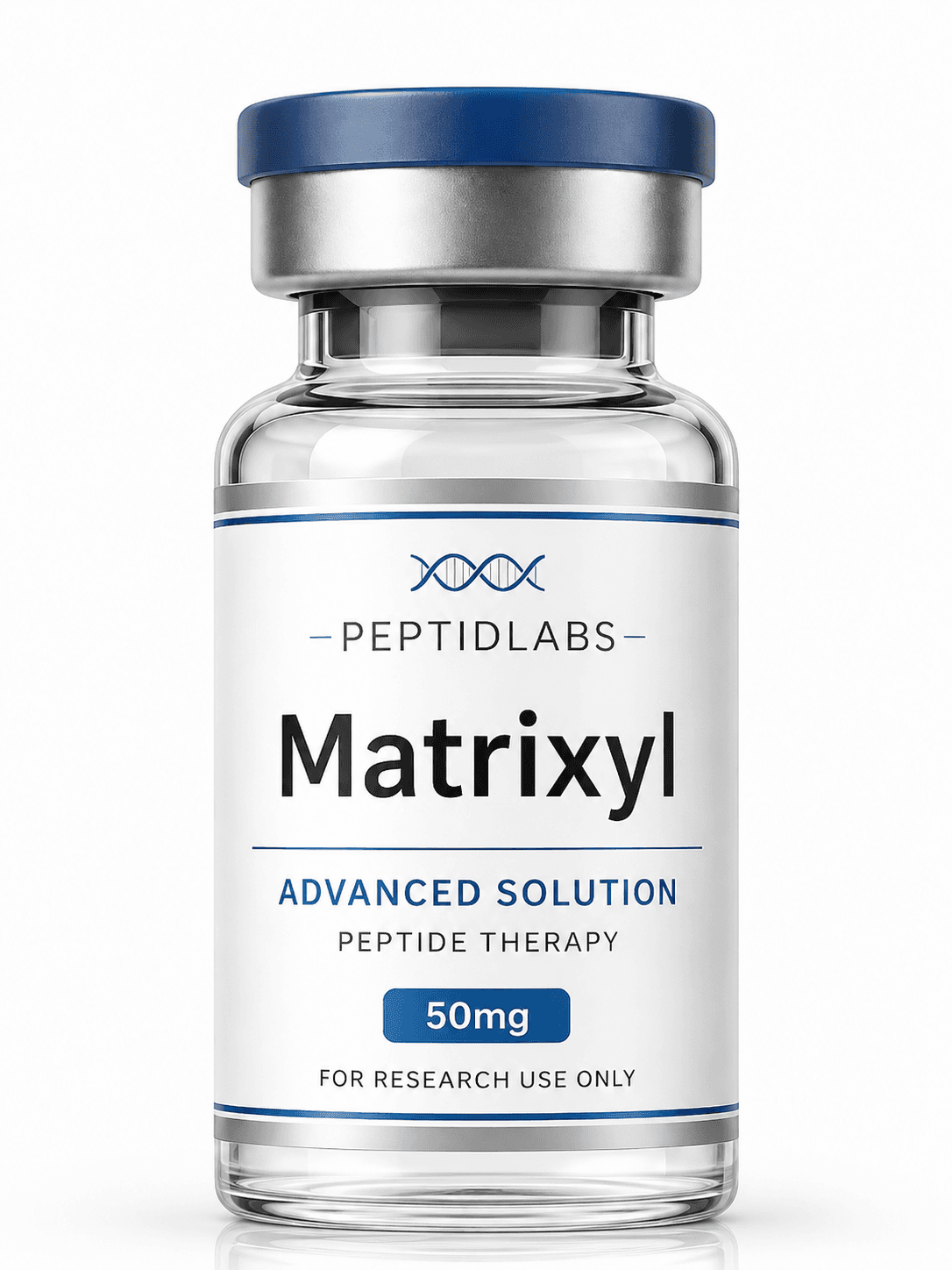
Matrixyl
Procollagen I Fragment | Matrikine Peptide | Skin Remodeling
In short
Studied for how it may help your skin build more collagen, which could support a firmer, smoother, and healthier appearance.
Best sellers
Related resources
Ready-to-use starter kit
Matrixyl (palmitoyl pentapeptide-4) is a synthetic peptide designed to mimic a natural fragment of the collagen structure. At the molecular level, it functions as a signaling molecule that binds to cellular receptors, triggering the synthesis of new collagen and other essential tissue components. Researchers study its mechanisms primarily in in vitro models focusing on extracellular matrix regeneration. This molecule is intended strictly for laboratory research purposes and is not an approved medication for human use.
Research reagent for laboratory use only. Not a medicine. For medical questions, consult a physician.
Scientific review
Written by
Калина Тодорова
Magister Pharmaciae, MSc Pharmacy
Reviewed by
Борис Маринов
MSc Biochemistry & Molecular Biology
Reviewed on
Matrixyl, chemically known as palmitoyl pentapeptide-4 (Pal-KTTKS), is a synthetic peptide derived from the procollagen I sequence. It functions as a matrikine, a signaling molecule that regulates cell activities in the extracellular matrix. The addition of a palmitoyl fatty acid chain enhances its lipophilicity, allowing it to penetrate the stratum corneum effectively. Researchers originally developed this peptide to stimulate collagen production and repair photodamaged skin. It is widely utilized in dermatological research and cosmetic formulations for its structural remodeling properties.
KTTKS pro-collagen feedback fragment Palmitoylated version for topical penetration Wrinkle volume -30-40% over 12 weeks (Robinson 2005) Skin density +15-25%
Pal-KTTKS mimics a natural cleavage product of collagen I that is released during extracellular matrix degradation. This fragment binds to specific receptors on dermal fibroblasts, signaling them to initiate the synthesis of new matrix components. It upregulates the production of collagen types I, III, and IV, as well as fibronectin and glycosaminoglycans like hyaluronic acid. This localized stimulation restores structural integrity to the dermal layer without inducing an inflammatory response.
Matrixyl signals fibroblasts to produce structural proteins, restoring volume and elasticity to aging skin.
Dosing
The typical regimens you'll see in the published research - for reference when planning in vitro or in vivo experiments. Not medical advice.
Reconstitute vial, then mix desired dose into a hyaluronic acid or neutral cream base immediately before application.
Apply reconstituted peptide solution to skin during or immediately after microneedling for enhanced penetration.
Disclaimer
These are regimens discussed in the research literature, not medical advice. Consult a healthcare provider before use.
Timing
Apply morning and evening to clean, dry skin before heavier creams.
[Calculator]
Change water and dose · results update in real time
from product
Visual indicator
Pull to mark 20
20marks
Standard insulin syringe 1 ml (100 marks)
Concentration
25.00mg/ml
Dose volume
0.200ml
U-100 units
20units
Doses per vial
10doses
Recommended needle
29G / 1 ml insulin
Standard for peptide dosing — widely stocked
Cycle planner: vials for 12 weeks, cost, schedule
Opens full calculator
Results are reference values - for in vitro work. Verify against the published literature for the specific peptide.
[Step by step]
6 steps from a sealed vial to the injection. Plain language.
Peptide vial (50 mg), bacteriostatic water vial, 1 larger syringe (3-5 ml) for drawing water and 1 insulin (1 ml) for doses. Alcohol swabs for sanitizing the caps.
Wash your hands before starting.
Wipe the rubber cap of the water vial with an alcohol swab. Insert the needle, invert the vial and draw exactly 2 ml. Get the exact volume from the calculator.
Larger syringe = smaller error in volume.
Wipe the peptide vial cap. Tilt the vial 45° and release the water SLOWLY down the inner wall. Peptides are fragile — a direct stream onto the powder denatures them.
SLOWLY · DOWN THE WALL · NOT ONTO THE POWDER.
Hold the vial between both palms and swirl slowly. DO NOT shake or flip sharply — peptides break down under mechanical stress.
DON'T SHAKE. Like tea — not like a cocktail.
The powder should fully dissolve. The solution is clear, no visible particles. If cloudy or with sediment — discard (wrong water or bad batch).
Clear = OK. Cloudy = discard.
With the insulin syringe draw the exact marks from the calculator. Swab the skin (abdomen 5 cm around the navel, thigh, or buttock), pinch a fold, insert at 45-90° and inject slowly.
Rotate sites every injection to avoid lipohypertrophy.
Schedule
Apply morning and evening to clean, dry skin before heavier creams.
Matrixyl is designed for topical absorption. The lyophilized powder must be reconstituted into a liquid solution and then blended into a suitable topical vehicle, as applying the raw aqueous solution directly may result in rapid evaporation and poor epidermal penetration.
Important
Matrixyl is designed for topical absorption. The lyophilized powder must be reconstituted into a liquid solution and then blended into a suitable topical vehicle, as applying the raw aqueous solution directly may result in rapid evaporation and poor epidermal penetration.
1. Remove the plastic cap from the peptide vial and wipe the rubber stopper with an alcohol swab.
2. Draw 2ml to 5ml of bacteriostatic water or sterile saline into a syringe, depending on desired concentration.
3. Inject the diluent slowly into the vial, directing the flow down the glass wall to avoid foaming.
4. Swirl the vial gently until the lyophilized powder is completely dissolved. Do not shake vigorously.
5. Extract the required liquid dose and mix it into a neutral carrier serum (e.g., hyaluronic acid) immediately before topical application.
Generally recognized as safe for topical application.
May cause mild, transient skin irritation or redness in sensitive individuals.
Not intended for systemic injection (intramuscular or intravenous).
Discontinue use if severe contact dermatitis or allergic reaction occurs.
References
Links to peer-reviewed publications on PubMed, cited in the peptide's scientific profile.
Topical palmitoyl pentapeptide provides improvement in photoaged human facial skin
Human | 93 females | 12 weeks | Wrinkle depth
Pal-KTTKS significantly decreased skin roughness and wrinkle depth compared to placebo. The peptide was well tolerated with no significant irritation reported during the trial period.
View the studyDetermining the macroscopic and microscopic changes in skin morphology following topical application of palmitoyl pentapeptide-4
In vitro / ex vivo | Human skin equivalents | 4 weeks | Collagen synthesis
The study demonstrated that Pal-KTTKS stimulates the production of collagen I and fibronectin in human skin models. It confirmed the peptide's ability to penetrate the stratum corneum and reach the dermal-epidermal junction.
Biologically active peptides: from a laboratory bench curiosity to a functional skin care product
Clinical review | Human subjects | Various | Matrix repair
Researchers detailed the development of Pal-KTTKS as a matrikine that mimics the natural tissue repair process. Clinical data showed significant improvements in skin thickness and elasticity across multiple trials.

for longevity

for sexual health
No reviews yet. Be the first.
Share your experience with this peptide. We publish after a short moderation.