sampleGLP-1/GCG dual
98%+ · 10mg · Lyophilized
Bulk discount
3+ pcs
€113.05
−5%
5+ pcs
€107.10
−10%
10+ pcs
€101.15
−15%
Discount is applied automatically at checkout.
Enter your email and we'll notify you when it's back:
Free shipping over €49
This product is sold strictly for in lab conditions (in vitro) research purposes. Not approved for human consumption.
Verified above 98%
98%+ verified — most batches reach 99%+
Included
Independent analysis from accredited laboratories
EU Shipping
3-7 days across the EU (Bulgaria — 1-2 days)
Secure Payment
Cash on delivery
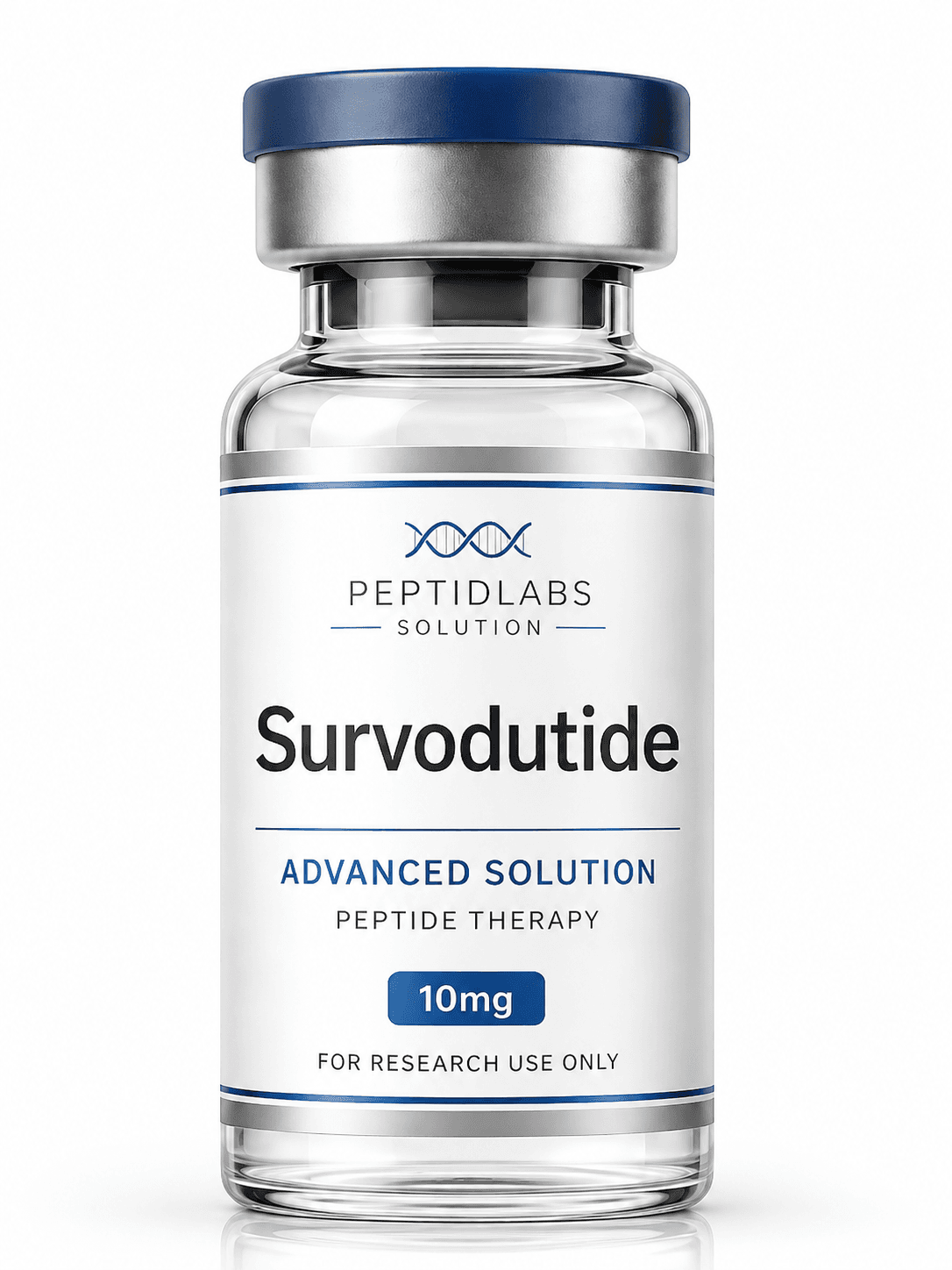
Survodutide
Dual GLP-1/Glucagon Receptor Agonist | Weight Loss & Diabetes
In short
Dual agonist of GLP-1 and glucagon receptors studied in clinical models of energy expenditure and metabolic control.
Best sellers
Related resources
Ready-to-use starter kit
Survodutide is an experimental synthetic peptide that acts as a dual agonist of the glucagon (GCGR) and GLP-1 receptors. At the molecular level, it binds to these two receptors, simultaneously slowing gastric emptying and stimulating energy expenditure and fat oxidation in the liver. Scientists are currently researching it in in vitro and animal models to understand its mechanism of action in metabolic processes. This product is intended strictly for laboratory research purposes and is not an approved medication for human use.
Research reagent for laboratory use only. Not a medicine. For medical questions, consult a physician.
Scientific review
Written by
Калина Тодорова
Magister Pharmaciae, MSc Pharmacy
Reviewed by
Борис Маринов
MSc Biochemistry & Molecular Biology
Reviewed on
Survodutide (BI 456906) is an investigational dual glucagon receptor (GCGR) and GLP-1 receptor (GLP-1R) agonist designed for once-weekly subcutaneous administration. This 29-amino acid peptide with C18 fatty acid acylation represents a novel approach to metabolic disease treatment by simultaneously targeting both energy intake reduction (via GLP-1R) and energy expenditure increase (via GCGR), demonstrating robust efficacy in clinical trials for obesity and metabolic dysfunction-associated steatohepatitis (MASH).
Dual GLP-1/glucagon (Boehringer Ingelheim) 18.7% weight loss (Phase 2 Lancet 2023) NASH resolution in 80% (Phase 2) Hepatic fatty acid oxidation
Balanced agonism of glucagon receptors (increases energy expenditure, hepatic fat oxidation) and GLP-1 receptors (reduces appetite, slows gastric emptying) with ~6-day half-life enabling weekly dosing
Phase 2 trial showed 14.9% mean weight loss at 46 weeks with 4.8mg dose, 55% achieving ≥15% weight loss
Superior weight loss vs semaglutide (-8.7% vs -5.3%) at 16 weeks in head-to-head trial
Dual mechanism addresses both energy intake and expenditure, potentially reducing weight regain
Dosing
The typical regimens you'll see in the published research - for reference when planning in vitro or in vivo experiments. Not medical advice.
Disclaimer
These are regimens discussed in the research literature, not medical advice. Consult a healthcare provider before use.
Timing
Any time of day, with or without food - maintain consistent weekly schedule
[Calculator]
Change water and dose · results update in real time
from product
Visual indicator
Pull to mark 5.0
5.0marks
Standard insulin syringe 1 ml (100 marks)
Concentration
5.00mg/ml
Dose volume
0.050ml
U-100 units
5.0units
Doses per vial
40doses
Recommended needle
29G–30G / 1 ml insulin
Small volume — draw slowly; 30G works for finer precision
Cycle planner: vials for 12 weeks, cost, schedule
Opens full calculator
Results are reference values - for in vitro work. Verify against the published literature for the specific peptide.
[Step by step]
6 steps from a sealed vial to the injection. Plain language.
Peptide vial (10 mg), bacteriostatic water vial, 1 larger syringe (3-5 ml) for drawing water and 1 insulin (1 ml) for doses. Alcohol swabs for sanitizing the caps.
Wash your hands before starting.
Wipe the rubber cap of the water vial with an alcohol swab. Insert the needle, invert the vial and draw exactly 2 ml. Get the exact volume from the calculator.
Larger syringe = smaller error in volume.
Wipe the peptide vial cap. Tilt the vial 45° and release the water SLOWLY down the inner wall. Peptides are fragile — a direct stream onto the powder denatures them.
SLOWLY · DOWN THE WALL · NOT ONTO THE POWDER.
Hold the vial between both palms and swirl slowly. DO NOT shake or flip sharply — peptides break down under mechanical stress.
DON'T SHAKE. Like tea — not like a cocktail.
The powder should fully dissolve. The solution is clear, no visible particles. If cloudy or with sediment — discard (wrong water or bad batch).
Clear = OK. Cloudy = discard.
With the insulin syringe draw the exact marks from the calculator. Swab the skin (abdomen 5 cm around the navel, thigh, or buttock), pinch a fold, insert at 45-90° and inject slowly.
Rotate sites every injection to avoid lipohypertrophy.
Schedule
Any time of day, with or without food - maintain consistent weekly schedule
Remove survodutide vial from refrigerator and allow to reach room temperature (15-30 minutes)
Clean rubber stoppers of both vials with alcohol swabs
Draw prescribed amount of bacteriostatic water into syringe
Insert needle into survodutide vial at 45-degree angle
Slowly inject BAC water down the side of vial to minimize foaming
Gently swirl vial - do not shake vigorously
Allow to sit for 2-3 minutes for complete dissolution
Solution should be clear to slightly opalescent without particles
Store reconstituted solution in refrigerator immediately
Common GI side effects: nausea (40-66%), diarrhea (25-49%), vomiting (15-41%)
Most GI effects occur during dose escalation - use flexible dosing if needed
Heart rate may increase slightly (mean 2-5 bpm) - monitor if cardiac conditions
Not recommended in pregnancy or breastfeeding - use contraception
No dose adjustment needed for hepatic impairment including cirrhosis
Monitor blood glucose if on diabetes medications - may need adjustment
References
Links to peer-reviewed publications on PubMed, cited in the peptide's scientific profile.
Phase 2 Obesity Trial Without Diabetes (2024)
Human | 0.6-4.8mg weekly | 46 weeks | Up to 14.9% weight loss
In 387 participants with BMI ≥27 kg/m² without diabetes, survodutide 4.8mg achieved mean 14.9% weight loss vs 2.8% placebo. 83% achieved ≥5% weight loss, 69% achieved ≥10%, and 55% achieved ≥15% weight loss.
Phase 2 MASH and Fibrosis Trial (2024)
Human | 2.4-6.0mg weekly | 48 weeks | 47-62% MASH improvement
In 293 participants with biopsy-confirmed MASH and fibrosis F1-F3, survodutide improved MASH without worsening fibrosis in 47% (2.4mg), 62% (4.8mg), and 43% (6.0mg) vs 14% placebo. Liver fat reduction ≥30% occurred in 63-67% of treated patients.
Phase 2 Type 2 Diabetes Trial (2023)
Human | 0.3-2.7mg weekly | 16 weeks | Superior to semaglutide
Head-to-head comparison showed survodutide achieved greater weight loss than semaglutide 1.0mg after 16 weeks (-8.7% vs -5.3%). HbA1c reductions were dose-dependent, reaching -1.6% with highest doses.
Preclinical Pharmacology Study (2022)
Animal/In vitro | Various doses | EC50 0.52nM GCGR, 0.33nM GLP-1R
Demonstrated balanced dual agonism with ~1:1 potency ratio at glucagon and GLP-1 receptors. Half-life of 44 hours in mice and 140 hours in dogs supported once-weekly dosing development.

for longevity

for sexual health
No reviews yet. Be the first.
Share your experience with this peptide. We publish after a short moderation.