What HPLC Purity Is and Why It Matters for Research Molecules | PeptidLabs | PeptidLabs
What HPLC Purity Is and Why It Matters for Research Molecules
·Калина Тодорова·8 min
HPLCКачествоCOA
Notice · content is for research purposes. The peptides described are not approved for human consumption and do not constitute medical advice.
3 citations·Reviewed 15 May 2026
Share
As a pharmacist and quality control specialist, I frequently analyze Certificates of Analysis (COAs) for various compounds in my laboratory practice. One of the most discussed yet least fully understood parameters in these documents is chromatographic purity. In the realm of synthetic molecules, the precision of research data depends entirely on the quality of the material used. Even minimal deviations in composition can compromise months of scientific work. This article objectively examines the analytical methods through which the scientific community validates research molecules, based on current pharmacopeial and analytical literature.
What HPLC Analysis and Mass Spectrometry Are
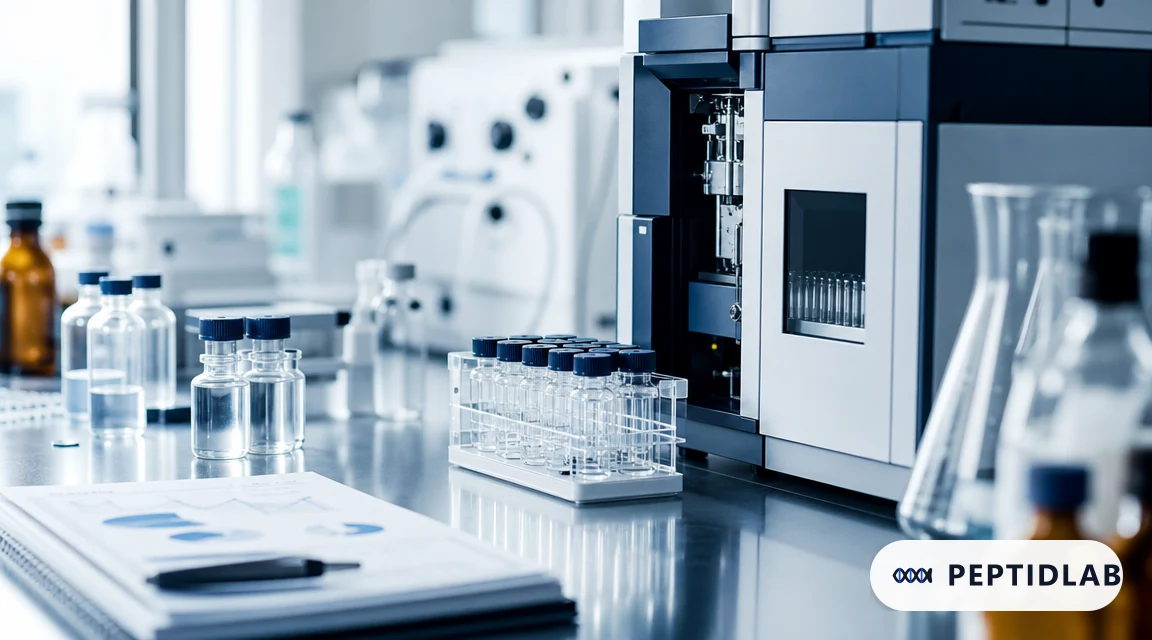
Visual concept for: What HPLC Analysis and Mass Spectrometry Are
High-Performance Liquid Chromatography (HPLC) is a fundamental analytical method in modern chemistry, used to separate, identify, and quantify components in a mixture. When analyzing research molecules, the HPLC system pumps a solvent (mobile phase) under high pressure through a column packed with a solid adsorbent (stationary phase). The various components of the tested sample interact differently with the stationary phase, causing them to be delayed and sequentially exit (elute) from the column at different times.
In the context of peptide purity HPLC, reverse-phase HPLC (RP-HPLC) is most commonly used. Here, the stationary phase is hydrophobic (usually silica gel modified with hydrocarbon chains like C18), and the mobile phase is a polar solvent, such as water and acetonitrile. Molecules are separated based on their hydrophobicity. When researchers examine a chromatogram, they look for one main, sharp peak representing the target molecule and a minimal number of additional small peaks representing impurities.
Although HPLC shows how many components are in the mixture and in what ratio, the method itself cannot confirm the chemical identity of the main peak. This is where Mass Spectrometry (MS) comes in. MS analysis ionizes the molecules and measures their mass-to-charge ratio (m/z). The combination of both methods (LC-MS) allows scientists to simultaneously determine the purity of the sample (via HPLC) and confirm that the main molecule has the exact molecular mass corresponding to its chemical formula.
What Studies Show About the Impact of Impurities
Visual concept for: What Studies Show About the Impact of Impurities
It is well documented in scientific literature that impurities in synthetic molecules can drastically alter the results of in vitro and in vivo experiments. During Solid-Phase Peptide Synthesis (SPPS), which is the standard production method, several specific types of impurities are generated [1].
The first group consists of deletion sequences. These are molecules missing one or more amino acids due to incomplete coupling during synthesis. The second group comprises truncated sequences, where synthesis has stopped prematurely. The third group includes products of chemical modification, such as oxidation of methionine or deamidation of asparagine, which can occur during purification or storage [2].
Researchers note that these impurities are often structurally very similar to the target molecule. In cell cultures, an impurity of 3-4% can act as a competitive antagonist. Studies show that if the impurity binds to the same receptor but does not activate it, it can block the action of the main molecule, leading to false-negative results in experimental models [3]. Conversely, if the impurity has its own distinct biological activity, it may trigger cellular responses that are mistakenly attributed to the tested substance. This is exactly why authors always state the analytical purity of the reagents used in published scientific papers.
Regulatory Status (BG/EU/US)
Visual concept for: Regulatory Status (BG/EU/US)
It is important to make a clear distinction between an analytical parameter and a regulatory status. HPLC purity is a measure of chemical quality, not a regulatory classification.
When a molecule has a certificate showing HPLC purity above 98%, this is a standard research benchmark indicating that the substance is suitable for laboratory in vitro experiments and preclinical animal models. However, this high purity does not turn the product into an approved drug.
In the European Union (EMA), Bulgaria (BDA), and the USA (FDA), approved medicinal products undergo rigorous clinical trials for safety and efficacy and are manufactured according to Good Manufacturing Practice (GMP) standards. Research grade chemicals, although proven by HPLC and MS to have high purity, are intended exclusively for scientific and laboratory use. They are not approved for human consumption, diagnostics, or therapy, regardless of their analytical profile.
What Scientists Still Don't Know (Method Limitations)
Although HPLC is a gold standard, analytical chemists acknowledge certain limitations of the technology. One of the main challenges is detecting co-eluting impurities. These are molecules that have identical hydrophobicity to the target molecule and pass through the chromatographic column in the exact same amount of time. As a result, they hide under the main peak on the chromatogram, creating the illusion of higher purity than actually exists.
Another significant limitation is isomeric resolution. During synthesis, stereoisomers can form (for example, the conversion of an L-amino acid to a D-amino acid). Standard reverse-phase HPLC often cannot distinguish these isomers because they have the same mass and similar polarity. To detect them, scientists must use specialized chiral columns or additional methods like Nuclear Magnetic Resonance (NMR), which complicates and increases the cost of the analytical process.
Furthermore, HPLC with ultraviolet (UV) detection measures light absorption. If an impurity lacks a chromophore (a structure that absorbs UV light at the specified wavelength), it will not be registered on the chromatogram at all, even if it is present in significant quantities in the sample.
Frequently Asked Questions
Q: What is the difference between HPLC and Mass Spectrometry (MS)?A: HPLC separates the components in a mixture and determines their quantitative ratio (purity percentage). Mass Spectrometry measures the mass of these components to confirm their chemical identity. The two methods complement each other in analytical chemistry.
Q: Why is purity above 98% considered a standard research benchmark?A: In scientific research, a purity of 98% or higher minimizes the risk of impurities affecting the results of in vitro or in vivo experiments. At lower purities, unidentified residual molecules can interact with cellular receptors and compromise data validity.
Q: Can HPLC analysis detect heavy metals or bacterial endotoxins?A: No. Standard HPLC methodology is designed for the analysis of organic molecules. Heavy metals are analyzed using methods like ICP-MS, and bacterial endotoxins are measured through specialized biological assays (such as the LAL test).
Q: Does high HPLC purity mean the product is safe for human use?A: No. HPLC purity is an analytical indicator of chemical composition, not a human safety certificate. Research molecules, regardless of their purity, are intended only for laboratory experiments and are not approved medicinal products.
Bibliography
[1] Kates, S. A., & Albericio, F. (2000). Solid-Phase Peptide Synthesis: A Practical Guide. Marcel Dekker.
[2] D'Hondt, M., et al. (2014). "Related impurities in peptide medicines." Journal of Pharmaceutical and Biomedical Analysis, 101, 2-30.
[3] Visser, E. J., et al. (2001). "High-performance liquid chromatography of peptides." Journal of Chromatography A, 926(1), 161-177.
This article is strictly educational and informational, based on a review of scientific literature and analytical chemistry. The research molecules and chemicals mentioned are intended solely for laboratory and scientific purposes (in vitro and in vivo models). They are not approved by regulatory authorities (such as the EMA, FDA, or local agencies) for the diagnosis, prevention, or treatment of human diseases. For any medical questions or health conditions, always consult a qualified physician.
Related research peptides
Research reagents for laboratory use. Not medications; not approved for human use.
BPC-157 — Body Protection Compound-157 | Pentadecapeptide.
Semaglutide — GLP-1 receptor agonist | Metabolic research peptide.
GHK-Cu — Copper-binding peptide | Tissue research and cellular regeneration models.