samplefor anti-aging
98%+ · 50mg · Lyophilized
Bulk discount
3+ pcs
€20.90
−5%
5+ pcs
€19.80
−10%
10+ pcs
€18.70
−15%
Discount is applied automatically at checkout.
Enter your email and we'll notify you when it's back:
Free shipping over €49
This product is sold strictly for in lab conditions (in vitro) research purposes. Not approved for human consumption.
Verified above 98%
98%+ verified — most batches reach 99%+
Included
Independent analysis from accredited laboratories
EU Shipping
3-7 days across the EU (Bulgaria — 1-2 days)
Secure Payment
Cash on delivery
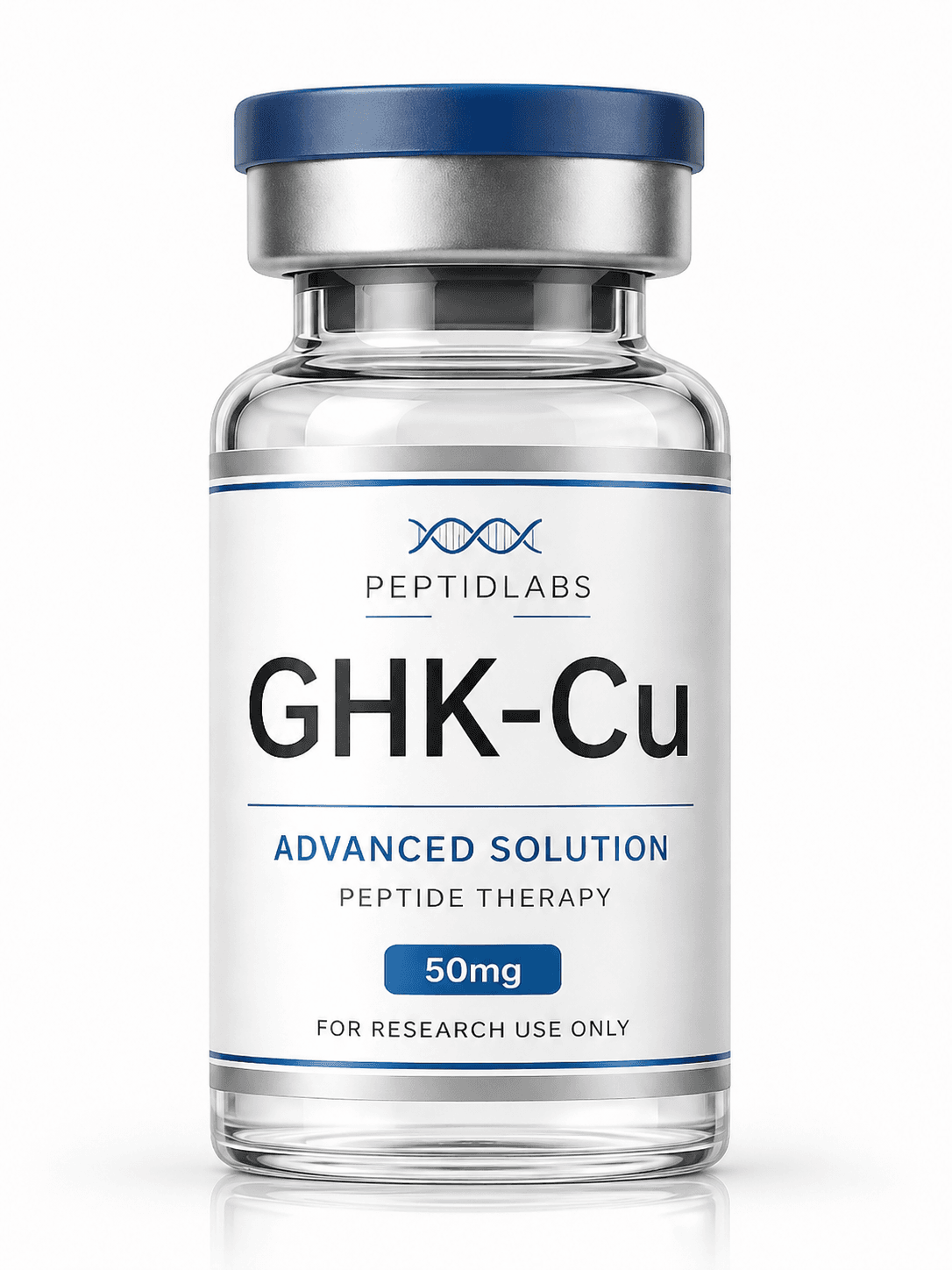
GHK-Cu
Copper Peptide | Skin Regeneration & Anti-Aging Compound
In short
Copper-binding tripeptide studied in dermatological models for modulating collagen synthesis and tissue regeneration.
Best sellers
Education
Related resources
Ready-to-use starter kit
GHK-Cu is a naturally occurring copper tripeptide, the levels of which naturally decline in the human body with age. At the molecular level, it delivers copper directly to tissues, activating fibroblasts and stimulating the synthesis of collagen and elastin. Researchers study this peptide in laboratory (in vitro) and animal models to observe its ability to modulate gene expression, promote angiogenesis, and regulate inflammatory responses. This molecule is provided strictly for research purposes, and its injectable form is not an FDA-approved medication.
Research reagent for laboratory use only. Not a medicine. For medical questions, consult a physician.
Scientific review
Written by
Калина Тодорова
Magister Pharmaciae, MSc Pharmacy
Reviewed by
Борис Маринов
MSc Biochemistry & Molecular Biology
Reviewed on
GHK-Cu is a naturally occurring copper tripeptide found in human plasma, saliva, and urine. Plasma levels decline from ~200 ng/ml at age 20 to ~80 ng/ml by age 60. Research shows it affects 31.2% of human genes and promotes wound healing, collagen synthesis, and anti-aging effects. Note: Injectable GHK-Cu is not FDA-approved; most clinical evidence comes from topical studies and animal models.
Activates 4192 genes in fibroblasts (Pickart 2012) — broad regenerative signal Cu²⁺ delivery to lysyl oxidase for collagen crosslinking Skin anti-aging: -30-40% wrinkles in 12 weeks (Finkley 2005) Decorin increase → reduced scarring S.c. half-life ~24 min
Topical GHK-Cu penetrates skin layers to deliver copper directly to target tissues. Activates fibroblasts, stimulates collagen and elastin synthesis, promotes angiogenesis, and modulates inflammatory responses for optimal skin regeneration
Increases type I and III collagen production by 70% for improved skin firmness, reduced wrinkle depth, and enhanced skin texture
Stimulates elastin synthesis for improved skin elasticity and resilience, reducing sagging and improving skin bounce-back
Strengthens the skin's protective barrier, improves moisture retention, and reduces transepidermal water loss
Dosing
The typical regimens you'll see in the published research - for reference when planning in vitro or in vivo experiments. Not medical advice.
Disclaimer
These are regimens discussed in the research literature, not medical advice. Consult a healthcare provider before use.
Timing
Morning and/or evening after cleansing
[Calculator]
Change water and dose · results update in real time
from product
Visual indicator
Pull to mark 20
20marks
Standard insulin syringe 1 ml (100 marks)
Concentration
25.00mg/ml
Dose volume
0.200ml
U-100 units
20units
Doses per vial
10doses
Recommended needle
29G / 1 ml insulin
Standard for peptide dosing — widely stocked
Cycle planner: vials for 12 weeks, cost, schedule
Opens full calculator
Results are reference values - for in vitro work. Verify against the published literature for the specific peptide.
[Step by step]
6 steps from a sealed vial to the injection. Plain language.
Peptide vial (50 mg), bacteriostatic water vial, 1 larger syringe (3-5 ml) for drawing water and 1 insulin (1 ml) for doses. Alcohol swabs for sanitizing the caps.
Wash your hands before starting.
Wipe the rubber cap of the water vial with an alcohol swab. Insert the needle, invert the vial and draw exactly 2 ml. Get the exact volume from the calculator.
Larger syringe = smaller error in volume.
Wipe the peptide vial cap. Tilt the vial 45° and release the water SLOWLY down the inner wall. Peptides are fragile — a direct stream onto the powder denatures them.
SLOWLY · DOWN THE WALL · NOT ONTO THE POWDER.
Hold the vial between both palms and swirl slowly. DO NOT shake or flip sharply — peptides break down under mechanical stress.
DON'T SHAKE. Like tea — not like a cocktail.
The powder should fully dissolve. The solution is clear, no visible particles. If cloudy or with sediment — discard (wrong water or bad batch).
Clear = OK. Cloudy = discard.
With the insulin syringe draw the exact marks from the calculator. Swab the skin (abdomen 5 cm around the navel, thigh, or buttock), pinch a fold, insert at 45-90° and inject slowly.
Rotate sites every injection to avoid lipohypertrophy.
Schedule
Morning and/or evening after cleansing
Cleanse skin thoroughly with gentle cleanser
Pat skin dry and wait 5 minutes for complete drying
Apply thin, even layer of GHK-Cu product to target areas
Massage gently until fully absorbed (1-2 minutes)
Follow with moisturizer if using serum formulation
Always apply sunscreen during daytime use
Redness at injection site
common
Metallic taste (systemic)
uncommon
Skin pigmentation darkening with prolonged topical use
rare
Compatibility
The pairings below come from research literature and established biohacker stacking patterns. Click a card for the full reasoning - when the partner is in our catalog you'll see a direct order link too.
This is a literature overview, not medical advice. Pairs not listed are not proven safe - they simply lack enough published data.
References
Links to peer-reviewed publications on PubMed, cited in the peptide's scientific profile.
Regenerative and Protective Actions of GHK-Cu Peptide
Review | Int J Mol Sci | 2018 | PMC6073405
Comprehensive review showing GHK affects 31.2% of human genes, with 59% upregulated and 41% downregulated. Demonstrates broad regenerative potential across multiple tissue types.
View the studyGHK Peptide in Skin Regeneration
Review | Biomed Res Int | 2015 | PMC4508379
GHK-Cu at 0.01-100 nM increased elastin and collagen production in human dermal fibroblasts. Demonstrates skin regeneration through multiple cellular pathways.
View the studyGHK and DNA: Resetting the Genome to Health
Review | Biomed Res Int | 2014 | PMC4180391
GHK resets genes of diseased cells to healthier states. Increases DNA repair genes (47 stimulated, 5 suppressed) and reverses COPD gene expression signature.
View the studyGHK-Cu in Prevention of Oxidative Stress and Aging
Review | Oxid Med Cell Longev | 2012 | PMC3359723
Cognitive enhancement demonstrated in aged mice at 10 mg/kg body weight. Shows neuroprotective and antioxidant effects with potential anti-aging applications.
View the study
for longevity

for sexual health
No reviews yet. Be the first.
Share your experience with this peptide. We publish after a short moderation.