exercise mimetic
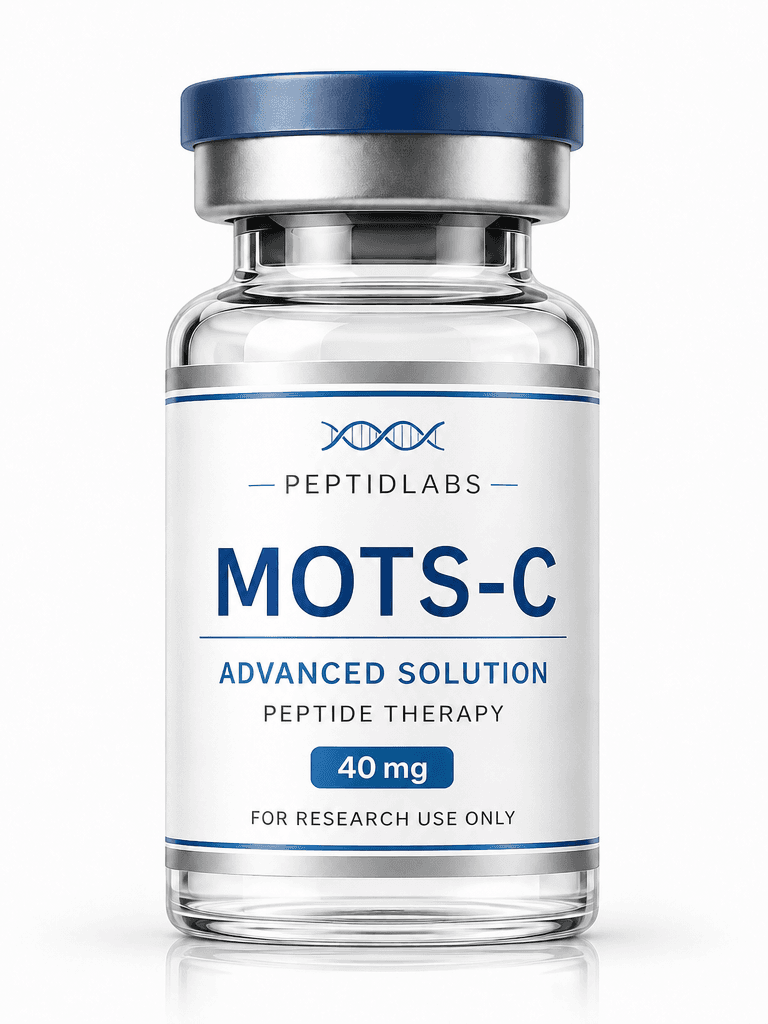
98%+ · 40mg · Lyophilized
Bulk discount
3+ pcs
€61.75
−5%
5+ pcs
€58.50
−10%
10+ pcs
€55.25
−15%
Discount is applied automatically at checkout.
🎉 One free — saved €65
Preview: offer goes live at launch.
The catalog is not yet accepting orders. Join the list.
In Stock - Ships within 24 hours
Free shipping over €49
This product is sold strictly for in lab conditions (in vitro) research purposes. Not approved for human consumption.
Verified above 98%
98%+ verified — most batches reach 99%+
Included
Independent analysis from accredited laboratories
EU Shipping
3-7 days across the EU (Bulgaria — 1-2 days)
Secure Payment
Cash on delivery
MOTS-c
Mitochondrial Open Reading Frame of the 12S rRNA-c
In short
Mitochondrially derived peptide studied for activating AMPK signaling and modulating insulin sensitivity.
Best sellers
Education
Related resources
Ready-to-use starter kit
MOTS-c is a 16-amino acid peptide naturally encoded by the mitochondrial genome that acts as an intracellular regulator. At the molecular level, it activates the AMPK pathway and translocates to the nucleus to regulate gene expression related to energy metabolism and metabolic stress response. The molecule is currently being investigated in in vitro and animal models to understand its effects on insulin sensitivity and cellular adaptation. This product is strictly for laboratory research purposes and is not an approved medication for human use.
Research reagent for laboratory use only. Not a medicine. For medical questions, consult a physician.
Scientific review
Written by
Калина Тодорова
Magister Pharmaciae, MSc Pharmacy
Reviewed by
Борис Маринов
MSc Biochemistry & Molecular Biology
Reviewed on
MOTS-c is a 16-amino acid mitochondrial-derived peptide encoded by the mitochondrial genome. It acts as a mitohormone that regulates metabolic homeostasis, enhances insulin sensitivity, and promotes longevity. MOTS-c operates through the Folate-AICAR-AMPK pathway and can translocate to the nucleus under metabolic stress to regulate gene expression.
MtDNA-derived peptide (12S rRNA) AMPK activation - exercise mimetic Improved insulin sensitivity in HFD models Retrograde mitochondrial signaling
MOTS-c operates through the Folate-AICAR-AMPK pathway, inhibiting the folate cycle and leading to AMPK activation. Under metabolic stress, it translocates to the nucleus and binds to stress-response transcription factors (NRF2, ATF1/ATF7) to regulate gene expression involved in metabolism, antioxidant response, and cellular stress adaptation.
Improves insulin sensitivity by ~30% in animal studies through AMPK activation. Enhances glucose uptake in skeletal muscle and improves glucose tolerance.
Clinical trials show improved glucose homeostasis. Restores metabolic function through enhanced insulin receptor sensitization and AMPK-mediated metabolic regulation.
Prevents obesity despite identical caloric intake in animal models. Promotes fatty acid oxidation and thermogenesis through mitochondrial activation.
Dosing
The typical regimens you'll see in the published research - for reference when planning in vitro or in vivo experiments. Not medical advice.
Disclaimer
These are regimens discussed in the research literature, not medical advice. Consult a healthcare provider before use.
Timing
Morning before exercise or with first meal
[Calculator]
Change water and dose · results update in real time
from product
Visual indicator
Pull to mark 20
20marks
Standard insulin syringe 1 ml (100 marks)
Concentration
20.00mg/ml
Dose volume
0.200ml
U-100 units
20units
Doses per vial
10doses
Recommended needle
29G / 1 ml insulin
Standard for peptide dosing — widely stocked
Cycle planner: vials for 12 weeks, cost, schedule
Opens full calculator
Results are reference values - for in vitro work. Verify against the published literature for the specific peptide.
[Step by step]
6 steps from a sealed vial to the injection. Plain language.
Peptide vial (40 mg), bacteriostatic water vial, 1 larger syringe (3-5 ml) for drawing water and 1 insulin (1 ml) for doses. Alcohol swabs for sanitizing the caps.
Wash your hands before starting.
Wipe the rubber cap of the water vial with an alcohol swab. Insert the needle, invert the vial and draw exactly 2 ml. Get the exact volume from the calculator.
Larger syringe = smaller error in volume.
Wipe the peptide vial cap. Tilt the vial 45° and release the water SLOWLY down the inner wall. Peptides are fragile — a direct stream onto the powder denatures them.
SLOWLY · DOWN THE WALL · NOT ONTO THE POWDER.
Hold the vial between both palms and swirl slowly. DO NOT shake or flip sharply — peptides break down under mechanical stress.
DON'T SHAKE. Like tea — not like a cocktail.
The powder should fully dissolve. The solution is clear, no visible particles. If cloudy or with sediment — discard (wrong water or bad batch).
Clear = OK. Cloudy = discard.
With the insulin syringe draw the exact marks from the calculator. Swab the skin (abdomen 5 cm around the navel, thigh, or buttock), pinch a fold, insert at 45-90° and inject slowly.
Rotate sites every injection to avoid lipohypertrophy.
Schedule
Morning before exercise or with first meal
Allow vial to reach room temperature (15-20 minutes)
Calculate required BAC water volume using calculator below
Draw BAC water into syringe
Inject slowly down vial side (not directly onto powder)
Gently swirl until dissolved (never shake vigorously)
Store reconstituted solution at 2-8°C and use within 14 days
Generally well-tolerated in animal studies with minimal side effects
Monitor blood glucose if using diabetes medications - may require dose adjustments
Limited long-term human safety data - use with appropriate medical supervision
May cause mild injection site reactions (redness, swelling)
Not recommended during pregnancy or breastfeeding
Prohibited by WADA for competitive athletes (metabolic modulator)
References
Links to peer-reviewed publications on PubMed, cited in the peptide's scientific profile.
Gestational Diabetes Mellitus (2022)
Mice | Daily administration during pregnancy | Throughout pregnancy | Alleviated hyperglycemia, improved maternal-fetal outcomes
Yin et al. showed MOTS-c significantly alleviated hyperglycemia in GDM mouse model, improved insulin sensitivity, and reduced birth weight abnormalities. Human study found significantly lower serum MOTS-c levels in GDM patients versus controls.
View the studyAcute Exercise Enhancement (2022)
Mice & Rats | 15 mg/kg single dose i.v. | Acute administration | 12% increased running time, 15% increased distance
Hyatt et al. showed single dose MOTS-c improved running time by 12% and distance by 15% in untrained mice. Chronic training increased MOTS-c protein expression 1.5-5-fold in muscle tissue, demonstrating both acute and chronic exercise-enhancing effects.
View the studyExercise Performance and Age-Dependent Physical Decline (2021)
Mice & Humans | 15 mg/kg 3x weekly (mice) | Variable duration | Enhanced physical performance across all age groups
Reynolds et al. demonstrated MOTS-c significantly enhanced physical performance in young, middle-aged, and old mice. Exercise induced 11.9-fold increase in skeletal muscle MOTS-c in humans. Acts as mitochondrial-encoded regulator of age-dependent physical performance.
View the studyNuclear Translocation Under Metabolic Stress (2018)
Cell culture & Mice | 1-10 μM in vitro | 30 min-24 hours | Nuclear translocation under stress
Kim et al. demonstrated MOTS-c rapidly translocates to nucleus within 30 minutes of metabolic stress. Once nuclear, it binds to stress-response transcription factors including NRF2 and ATF1/ATF7 to regulate antioxidant and stress-response genes.
View the studyCoronary Endothelial Dysfunction (2018)
Human patients (n=40) | Observational study | - | Lower MOTS-c levels correlate with endothelial dysfunction
Qin et al. found MOTS-c plasma levels were significantly lower in patients with endothelial dysfunction. Circulating MOTS-c positively correlated with both microvascular and epicardial coronary endothelial function. First human study linking MOTS-c to cardiovascular health.
View the studyMetabolic Homeostasis and Obesity Prevention (2015)
Mice | 0.5-5 mg/kg/day i.p. | 3-8 weeks | Prevented obesity, improved insulin sensitivity by ~30%
Foundational study by Lee et al. demonstrating MOTS-c prevents obesity in high-fat diet-fed mice despite identical caloric intake. Restored insulin sensitivity in aged mice to levels comparable to young animals through the folate-AICAR-AMPK pathway.
View the study
for longevity

for sexual health
No reviews yet. Be the first.
Share your experience with this peptide. We publish after a short moderation.