sampleregenerative quartet
98%+ · 80mg · Lyophilized
Bulk discount
3+ pcs
€122.55
−5%
5+ pcs
€116.10
−10%
10+ pcs
€109.65
−15%
Discount is applied automatically at checkout.
🎉 One free — saved €129
Preview: offer goes live at launch.
The catalog is not yet accepting orders. Join the list.
In Stock - Ships within 24 hours
Free shipping over €49
This product is sold strictly for in lab conditions (in vitro) research purposes. Not approved for human consumption.
Verified above 98%
98%+ verified — most batches reach 99%+
Included
Independent analysis from accredited laboratories
EU Shipping
3-7 days across the EU (Bulgaria — 1-2 days)
Secure Payment
Cash on delivery
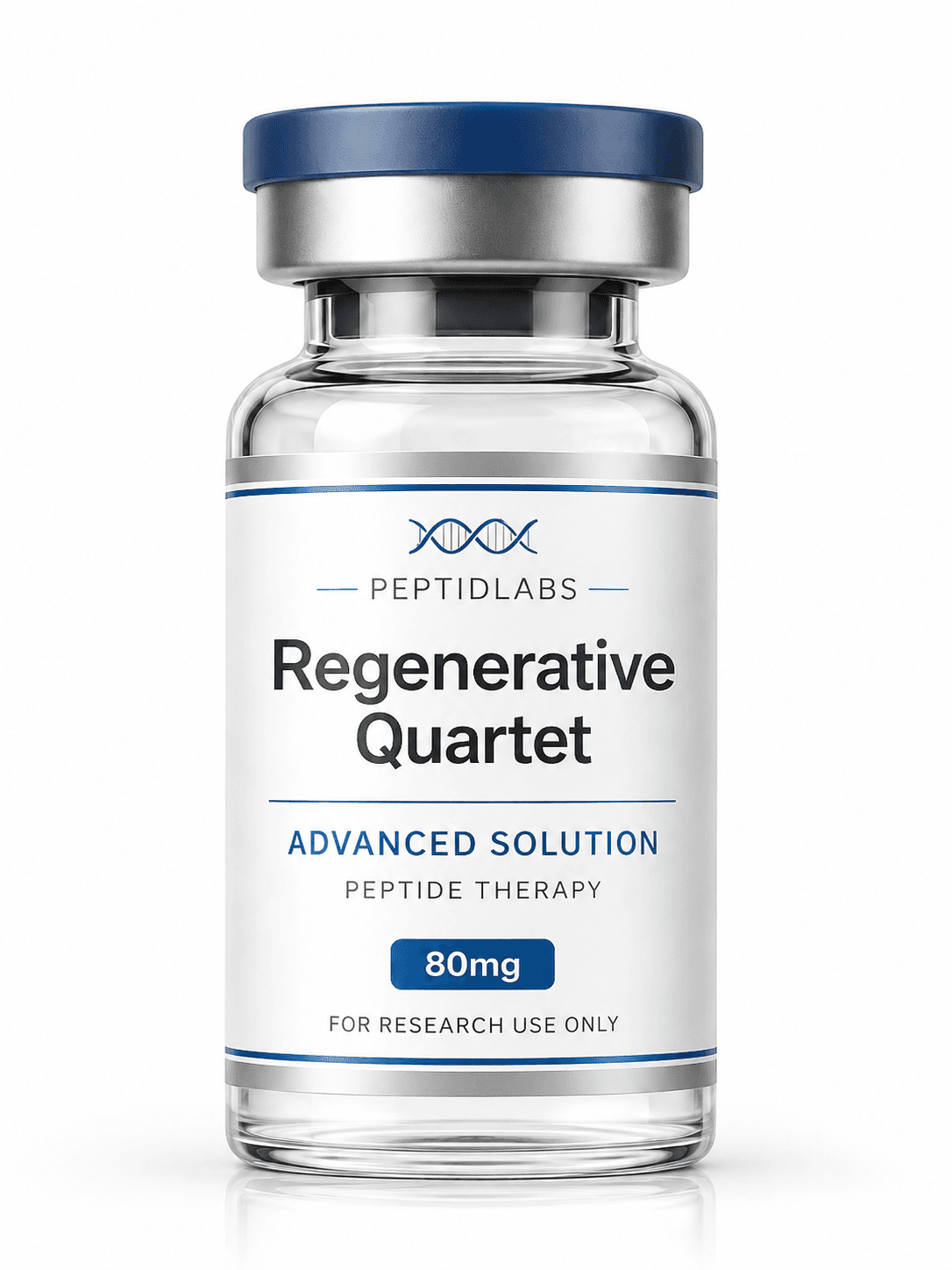
Regenerative Quartet
Peptide Blend | Tissue Repair | Inflammation Modulation
In short
Studied for how it may help your body repair damaged tissues and recover faster from injuries. It is researched to support your natural healing process.
Best sellers
Education
Related resources
Ready-to-use starter kit
Regenerative Quartet is a research peptide blend containing a combination of BPC-157, GHK-Cu, TB-500, and KPV. At the molecular level, this formula acts by stimulating the formation of new blood vessels, delivering copper ions for collagen synthesis, regulating cellular migration, and suppressing inflammatory markers. Scientists are currently investigating these mechanisms primarily in in vitro and animal models to study tissue repair processes. This product is strictly for laboratory research purposes and is not an approved medication or therapeutic product for human use.
Research reagent for laboratory use only. Not a medicine. For medical questions, consult a physician.
Scientific review
Written by
Калина Тодорова
Magister Pharmaciae, MSc Pharmacy
Reviewed by
Борис Маринов
MSc Biochemistry & Molecular Biology
Reviewed on
Regenerative Quartet is a lyophilized blend combining four distinct peptides into a single 80 mg vial. The formulation includes 10 mg of BPC-157, 50 mg of GHK-Cu, 10 mg of TB-500, and 10 mg of KPV. This combination targets multiple physiological pathways simultaneously to support tissue repair. BPC-157 and TB-500 facilitate angiogenesis and cellular migration. GHK-Cu and KPV provide structural fibroblast support and modulate inflammatory cytokines.
Combined regenerative cascade coverage BPC-157 + TB-500 + GHK-Cu + KPV - all levels Achilles tendon recovery -50-60% time vs single Standard protocol for multi-tissue research
BPC-157 accelerates angiogenesis through VEGFR2 activation, creating new capillary networks. GHK-Cu delivers copper ions to fibroblasts to stimulate collagen and elastin synthesis. TB-500 binds to G-actin to upregulate cellular migration toward vascularized areas. KPV inhibits NF-κB and reduces TNF-α and IL-6 expression to lower systemic inflammatory responses.
Combines angiogenesis from BPC-157 with fibroblast activation from GHK-Cu to repair damaged structures.
Dosing
The typical regimens you'll see in the published research - for reference when planning in vitro or in vivo experiments. Not medical advice.
Administer near the site of injury if possible.
Rotate injection sites across the abdomen.
Disclaimer
These are regimens discussed in the research literature, not medical advice. Consult a healthcare provider before use.
Timing
Administer at a consistent time daily, preferably away from meals.
[Calculator]
Change water and dose · results update in real time
from product
Visual indicator
Pull to mark 20
20marks
Standard insulin syringe 1 ml (100 marks)
Concentration
40.00mg/ml
Dose volume
0.200ml
U-100 units
20units
Doses per vial
10doses
Recommended needle
29G / 1 ml insulin
Standard for peptide dosing — widely stocked
Cycle planner: vials for 12 weeks, cost, schedule
Opens full calculator
Results are reference values - for in vitro work. Verify against the published literature for the specific peptide.
[Step by step]
6 steps from a sealed vial to the injection. Plain language.
Peptide vial (80 mg), bacteriostatic water vial, 1 larger syringe (3-5 ml) for drawing water and 1 insulin (1 ml) for doses. Alcohol swabs for sanitizing the caps.
Wash your hands before starting.
Wipe the rubber cap of the water vial with an alcohol swab. Insert the needle, invert the vial and draw exactly 2 ml. Get the exact volume from the calculator.
Larger syringe = smaller error in volume.
Wipe the peptide vial cap. Tilt the vial 45° and release the water SLOWLY down the inner wall. Peptides are fragile — a direct stream onto the powder denatures them.
SLOWLY · DOWN THE WALL · NOT ONTO THE POWDER.
Hold the vial between both palms and swirl slowly. DO NOT shake or flip sharply — peptides break down under mechanical stress.
DON'T SHAKE. Like tea — not like a cocktail.
The powder should fully dissolve. The solution is clear, no visible particles. If cloudy or with sediment — discard (wrong water or bad batch).
Clear = OK. Cloudy = discard.
With the insulin syringe draw the exact marks from the calculator. Swab the skin (abdomen 5 cm around the navel, thigh, or buttock), pinch a fold, insert at 45-90° and inject slowly.
Rotate sites every injection to avoid lipohypertrophy.
Schedule
Administer at a consistent time daily, preferably away from meals.
Due to the high concentration of GHK-Cu, the reconstituted solution may have a distinct blue tint and can cause transient injection site discomfort. Diluting with a larger volume of bacteriostatic water can mitigate this effect.
Important
Due to the high concentration of GHK-Cu, the reconstituted solution may have a distinct blue tint and can cause transient injection site discomfort. Diluting with a larger volume of bacteriostatic water can mitigate this effect.
1. Remove the vial from the refrigerator and allow it to reach room temperature.
2. Swab the rubber stoppers of both the peptide vial and bacteriostatic water with alcohol.
3. Draw the required volume of bacteriostatic water (e.g., 4-8 mL due to the large 80mg mass) into the syringe.
4. Slowly inject the water into the peptide vial, directing the flow against the glass wall.
5. Gently swirl the vial until the lyophilized powder is completely dissolved. Do not shake.
6. Store the reconstituted solution in the refrigerator immediately.
Injection-site reaction
uncommon
Mild nausea (oral administration)
uncommon
References
Links to peer-reviewed publications on PubMed, cited in the peptide's scientific profile.
Gastric pentadecapeptide BPC 157 promotes healing of transected rat Achilles tendon
Animal | 4 weeks | Tendon healing
BPC-157 significantly improved the biomechanical properties of healed tendons. It promoted angiogenesis and collagen formation.
The human tripeptide GHK-Cu in prevention of oxidative stress and degenerative conditions of aging
Human/In vitro | Review | Tissue repair
GHK-Cu modulated the expression of multiple genes related to tissue repair. It increased collagen synthesis and reduced inflammatory markers.
Thymosin beta4: actin-sequestering protein moonlights to repair injured tissues
Animal/In vitro | Review | Cell migration
Thymosin beta-4 promoted wound healing by accelerating endothelial cell migration. It facilitated angiogenesis and reduced scar tissue formation.
Alpha-MSH related peptides: a new class of anti-inflammatory agents
Animal | Various | Inflammation
The tripeptide KPV exhibited potent anti-inflammatory effects without melanotropic activity. It inhibited NF-κB activation and reduced pro-inflammatory cytokine release.
No reviews yet. Be the first.
Share your experience with this peptide. We publish after a short moderation.